
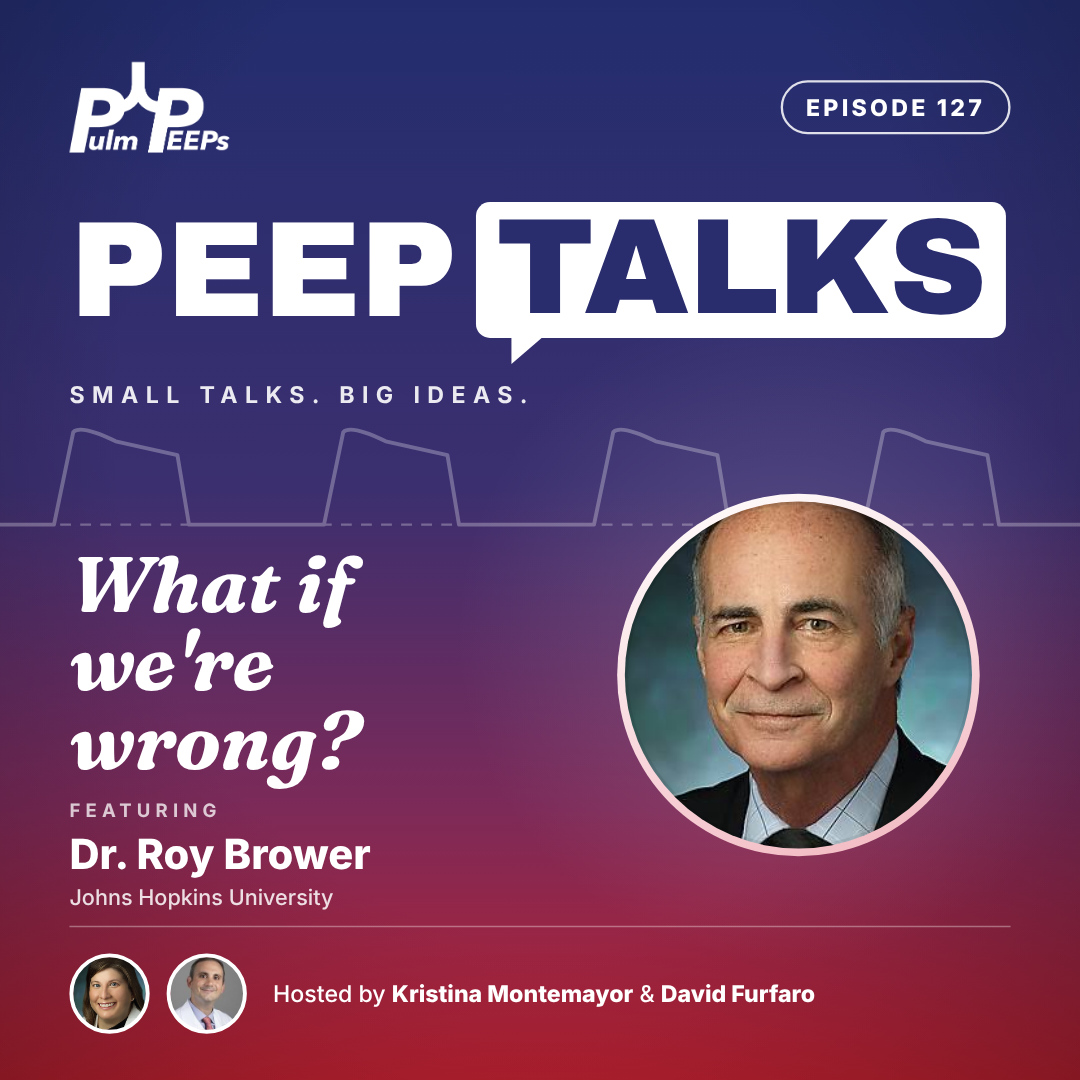
What if we’re wrong? It’s a simple question, but it’s surprisingly hard to ask in medicine. In the first episode of PEEP Talks, Furf and Monty sit down with Dr. Roy Brower, whose work with the ARDS Network changed how we ventilate patients with ARDS. Rather than a lecture on ARDS, this is a conversation about challenging conventional wisdom. We talk about how the shift to lung-protective ventilation began, what the landmark low tidal volume trial looked like from the inside, why good evidence takes years to change practice, and which assumption in critical care Roy thinks deserves more scrutiny today.
About PEEP Talks:
PEEP Talks is a new Pulm PEEPs series. The concept is simple: one guest, one big idea, and a conversation that stays with you long after it’s over.
Meet Our Guest
Dr. Roy Brower is a true Hopkins lifer. He earned his MD at Johns Hopkins University School of Medicine in 1976 and completed residency and fellowship there in 1984. He is Professor of Medicine at Johns Hopkins and served as Medical Director of the Johns Hopkins Hospital MICU from 1988 to 2021. A founding investigator in the NIH ARDS Network, he helped lead the trials that established lower tidal volume ventilation as the standard of care in ARDS. His honors include two Residents’ Teaching Awards, a Fellows’ Teaching Award and the ATS Critical Care Assembly Lifetime Achievement Award. Roy previously joined us for our PEEP in ARDS Roundtable, and he is the first guest of PEEP Talks.
Key Learning Points
The Old Way Wasn’t Irrational
In the early 1990s, most patients with ARDS were dying, despite new broad-spectrum antibiotics, faster resuscitation and better prophylaxis. At the time, clinicians routinely ventilated with tidal volumes of 10 to 15 mL/kg, and for reasons that made sense:
- Dead space: Ashbaugh, Petty and colleagues, who first described the syndrome in 1967, used large tidal volumes because the high dead space in ARDS meant patients needed a lot of ventilation to keep PCO2 normal and avoid acidosis.
- The operating room: anesthesiologists found that patients with normal lungs ventilated at about 6 mL/kg became hypoxemic within an hour or two, but those ventilated at 10 to 15 mL/kg did not.
ICU physicians took their cues from both. A physiologic rationale existed; the outcome just wasn’t there.
What Made Them Question It
Roy is clear that there was no single observation. “If you oversimplify things thinking there’s one key observation or bit of evidence, you’ll probably make a lot of mistakes.” Several pieces came together:
- Too many patients were dying. It “just didn’t feel right.”
- Laboratory evidence: in animal models, rats ventilated with large tidal volumes developed interstitial and alveolar edema, hyaline membranes and acute inflammation in less than an hour. It looked “for all the world like ARDS.” Perhaps some patients would have recovered from their pneumonia or sepsis if not for a second, ventilator-induced lung injury.
- Hickling’s case series: Keith Hickling in New Zealand reported unexpectedly high survival with a low tidal volume, permissive hypercapnia approach. In one graph, four patients had a PCO2 above 100, and three of the four survived.
- Reframing the goal: a smaller tidal volume comes at a price (hypercapnia, acidosis, somewhat worse oxygenation), but “the end result we’re looking for is not normal acid-base balance, it’s survival.”
The “we” started small: Roy’s colleagues in the Hopkins medical and surgical ICUs, and mentors like Sol Permutt, who pointed him to a 1960s paper of more than 300 isolated canine lung lobes exploring how ventilation affects the lung. A pilot study across four Baltimore hospitals followed, and the ARDS Network held its first meeting in late 1994. As Dave put it, in-person conversations with the people you work with every day are what “give these ideas some oxygen.”
The ARDS Network Trial, From the Inside
Everyone came to the table with different ideas. Despite similar training, the investigators disagreed about nearly everything. One said he never raised PEEP above 5 until the FiO2 reached 100%; another never raised the FiO2 above 50% until the PEEP was 20. Because the trial couldn’t be blinded, they needed to control PEEP and FiO2 so both arms were treated alike. After hours of debate, they produced the PEEP/FiO2 table, a compromise everyone could accept: “It’s not how I do it, but I think I can live with it, and more importantly, I think I can sell it to my colleagues back home.”
Delivering 6 mL/kg was hard at first. Research coordinators would hope for the traditional arm at randomization because those patients were comfortable. With low tidal volumes, patients were often dyspneic, and nurses and respiratory therapists asked, in effect, “Why are you torturing my patient?” Once teams got used to it, it became manageable: a little more sedation, a little more hand-holding, and keeping “our eye on the prize, the prize being survival in the long term, not breathing comfort the next hour.”
Nobody knew the answer. With only about one patient per hospital per month, no one could see the effect, even in an unblinded trial. Near the end, the investigators each put a dollar down on the result. The average bet was zero: half thought lower tidal volumes would win and half thought higher. The final result was an absolute mortality reduction of about 9% with lower tidal volumes. (For the trial details, listen back to our RFJC episode on ARMA from the ARDS summer series.)
Why Good Evidence Takes Years to Change Practice
Publishing the result wasn’t the end. Roy estimates it took at least five years before most patients were managed with lower tidal volumes. Two reasons stand out:
- Skepticism about the trial design, including the argument that the control arm used higher tidal volumes than were common in practice. Roy doesn’t think the data supported that, but the idea was out there.
- The immediate feedback is all bad. Lower tidal volumes bring tachypnea, agitation, rising PCO2 and sometimes worse oxygenation. No one can look at a single patient and say “this one needs 6 mL/kg or he’ll die,” or look at a patient on 12 mL/kg and say “you’re killing him.” Even in the traditional arm, about 60% of patients survived.
And then there’s human nature. We learn something in training, use it in practice, teach it to students and residents, and “the idea takes on a life of its own.” Admitting that what we believed and taught for years was wrong is painful. The truth sets you free, but sometimes the truth hurts, and when it hurts, we tend to deny it.
One sign that practice had changed: later trials of other lung-protective strategies used low tidal volume ventilation as their control arm.
Never Be Sure You’re Right
Asked whether we could do a better job teaching trainees to keep asking “why,” Roy’s answer was an emphatic yes, along with a lesson he says he has learned many times: you should never be sure you’re right. Medicine has too many moving parts and too many unknowns. Stay open to the idea that there may be a better way to think about a problem, listen to your colleagues and your critics, and collaborate. In the words of Satchel Paige: “Ain’t no one of us as smart as all of us.”
The tension, as Dave noted, is that we also need clinicians confident enough to make hard decisions. The goal is confidence to act, paired with the humility to keep questioning.
What Might We Be Getting Wrong Today? PEEP
Given the chance to name an assumption in critical care that deserves more scrutiny, Roy chose a favorite: the belief that we should use relatively high PEEP in ARDS.
- Where the idea comes from: in animal models, some PEEP protects against injury from repeated alveolar collapse and reopening, and the most protective levels were higher than those used clinically. Connect the dots, and higher PEEP seems logical.
- Why to be cautious: those were animal models, and PEEP has a price. Higher PEEP brings hemodynamic effects, higher airway pressures and overdistension injury. The most lung-protective approach is not necessarily the most patient-protective one, and “it’s patient protection that ultimately we’re after.”
- What the trials show: four large randomized trials of higher vs. lower PEEP, with more than 3,000 patients, found no overall benefit, and one showed harm with higher PEEP.
- Watch your terminology: the ARDS Network “lower PEEP table” is only lower relative to the higher PEEP table designed for a later trial. It actually provides equal or higher PEEP than much of usual clinical practice.
Will technology solve it? Tools such as electrical impedance tomography (EIT), which maps overdistension, tidal recruitment and atelectasis across the lung, might move us in a positive direction. But images that look like they ought to work aren’t enough. To change practice, we need data showing better outcomes: lower mortality and less time on the ventilator.
The PEEP Talk Takeaways
- A physiologic rationale is not the same as a better outcome. Large tidal volumes normalized blood gases, and patients still died.
- Change rarely comes from a single observation. It comes from patient outcomes, lab science and early clinical signals pieced together, without oversimplifying.
- Ideas need oxygen. The questions that changed ARDS care began in conversations among ICU colleagues and grew into a national network.
- Good science requires compromise and equipoise. Investigators who disagreed built a protocol they could all live with, and even they couldn’t predict the result.
- Evidence alone doesn’t change practice. When the immediate feedback is all bad and the benefit only shows up across many patients, expect skepticism and years of lag.
- Never be sure you’re right. Today’s assumptions, high PEEP among them, deserve the same scrutiny that tidal volume once got.
“Ain’t no one of us as smart as all of us.” Satchel Paige
Thank you to Dr. Brower for being our first PEEP Talks guest. Small talks. Big ideas. We’ll see you next time.
Related Pulm PEEPs Episodes
References and Further Reading
- Ashbaugh DG, Bigelow DB, Petty TL, Levine BE. “Acute respiratory distress in adults.” Lancet. 1967;2(7511):319–323.
- Hickling KG, Henderson SJ, Jackson R. “Low mortality associated with low volume pressure limited ventilation with permissive hypercapnia in severe adult respiratory distress syndrome.” Intensive Care Med. 1990;16(6):372–377.
- Hickling KG, Walsh J, Henderson S, Jackson R. “Low mortality rate in adult respiratory distress syndrome using low-volume, pressure-limited ventilation with permissive hypercapnia: a prospective study.” Crit Care Med. 1994;22(10):1568–1578.
- Acute Respiratory Distress Syndrome Network. “Ventilation with lower tidal volumes as compared with traditional tidal volumes for acute lung injury and the acute respiratory distress syndrome.” N Engl J Med. 2000;342(18):1301–1308.
- Brower RG, Lanken PN, MacIntyre N, et al. “Higher versus lower positive end-expiratory pressures in patients with the acute respiratory distress syndrome.” N Engl J Med. 2004;351(4):327–336.
- Meade MO, Cook DJ, Guyatt GH, et al. “Ventilation strategy using low tidal volumes, recruitment maneuvers, and high positive end-expiratory pressure for acute lung injury and acute respiratory distress syndrome: a randomized controlled trial.” JAMA. 2008;299(6):637–645.
- Mercat A, Richard JC, Vielle B, et al. “Positive end-expiratory pressure setting in adults with acute lung injury and acute respiratory distress syndrome: a randomized controlled trial.” JAMA. 2008;299(6):646–655.
- Writing Group for the Alveolar Recruitment for ARDS Trial (ART) Investigators. “Effect of lung recruitment and titrated PEEP vs low PEEP on mortality in patients with acute respiratory distress syndrome: a randomized clinical trial.” JAMA. 2017;318(14):1335–1345.