Today we’re joined by Dr. Molly Hayes and talking about an upcoming CME course: Principles of Critical Care Medicine for Non-Intensive Care Specialists. This is a wonderful education course covering a wide array of topics in critical care in a case-based, systematic, and peer-reviewed fashion. The course is interactive and all resources will be available for attendees afterwards for their review. You can sign up at https://learn.hms.harvard.edu/criticalmed and save using the discount code “PulmPEEPS50”!
Meet Our Guest
Dr. Molly Hayes is an Associate Professor of Medicine at Beth Israel Deaconess Medical Center and Harvard Medical School, the Director of the MICU at BIDMC, and the Director of External Education at the Carl J Shapiro Institute for Education and Research. She additionally is a co-founder of the BIDMC Center for Humanizing the ICU.
Hey everyone, Dave Furfaro here from Pulm PEEPs. As you may have noticed in the last few weeks and months, we’ve had a little bit of a decrease in the content that we’ve been putting out, and I just wanted to share a couple things with you about why that is and the future of Pulm PEEPs coming up. In December of 2025, I was diagnosed with a large myxoid liposarcoma in my leg, and since then, I have been undergoing treatment for that.
Overall, treatment has been going well, but it’s certainly been a long road that, continues, and I hope that it continues to trend positively. Kristina has been an unbelievable support during this. We have continued to work on some content as a great way and distraction for me at times, but we haven’t been able to keep up the same pace of content that we usually put out. And given everything that is going on, I actually anticipate that will continue for a few months. Ee haven’t said anything so far yet because we were still figuring it out ourselves, but now we just wanted you all to know that, we, love doing Pulm PEEPs. We’re very committed to it. We wanna get back to doing it as consistently as we have been previously, and we plan on doing that, but it likely will be a little bit of time, and this is why.
I also may be sharing more about my journey through the medical system as a patient, in the future, but for now, I’m really just focusing on my treatment, my health, and my family. So the summer months will likely be, much slower, maybe even a break off together, and look forward to recovering and getting back to producing more regular Pulm PEEPs content in the Fall.
Hope everybody who’s listening is doing well. Thank you all, as always, for being supportive, for listening to the podcast, for reaching out to us on social media, for saying hi to us in person at conferences. It’s been, a true delight, and we can’t wait to get back to business as usual. Okay, everybody. Take good care of patients, be safe, be well, and we’ll see you soon.
For today’s podcast we have a special episode. We were extremely grateful to be invited to present live at CHEST 2025 this year. Kristina Montemayor, and Pulm PEEPs Associate Editors Luke Hedrick, Tom Di Vitantonio, and Rupali Sood hosted a session entitled “Widened Airways and Narrowed Differentials”. It is a great session around bronchiectasis. Enjoy!
Meet Our Guests
Dr. Doreen Addrizzo-Harris is a Professor of Medicine at NYU where she is also Associate Director of Clinical and Academic Affairs for the pulmonary and critical care division. In addition to that, she’s the director of the bronchiectasis and NTM program and also serves as a program director for the pulmonary and critical care fellowship.
Case Snapshot
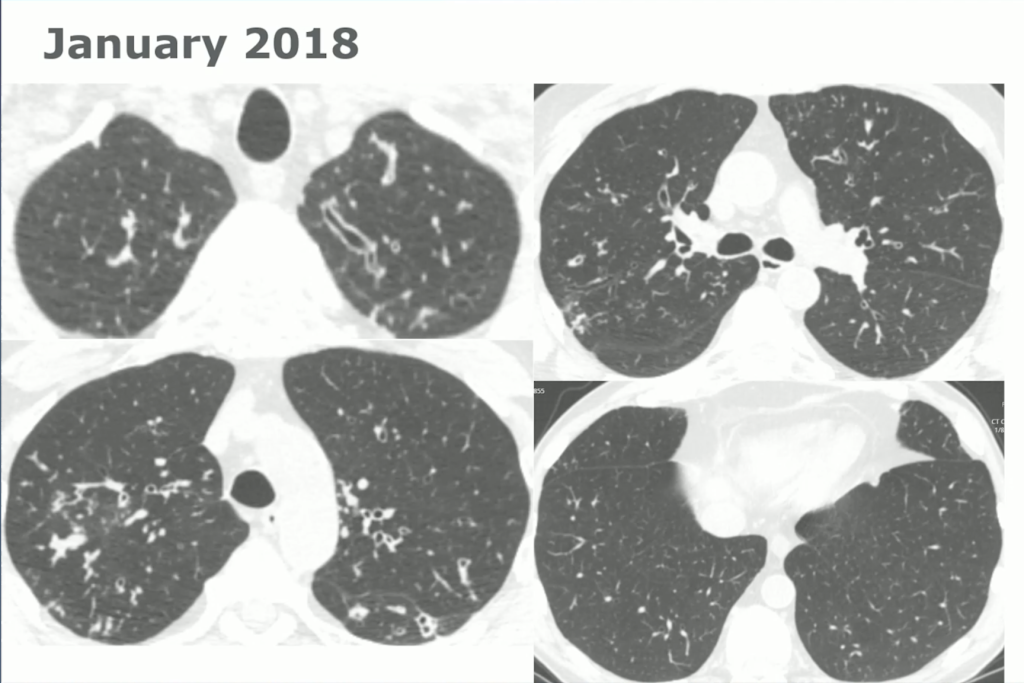
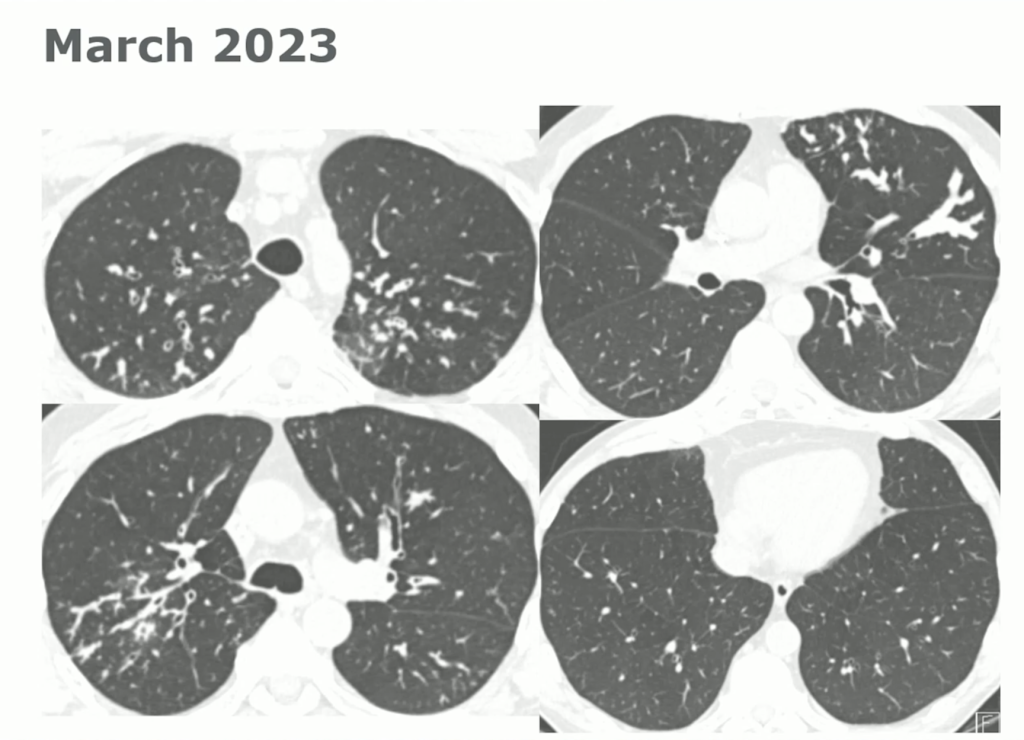
60-year-old with CLL (in remission) → recurrent “pneumonias,” diffuse (not single-lobe), later dx’d with CVID; serial CTs: upper-lobe–predominant bronchiectasis, tree-in-bud, mucus impaction; multiple AFB+ cultures (MAC, later M. abscessus); recurrent bacterial flares (MSSA/MRSA).
CT Images
Key Learning Points
Imaging pearls
Tree-in-bud = small airways (bronchiolar) impaction/inflammation, not a diagnosis. Differential guided by distribution + chronicity:
Acute/diffuse → bacterial/viral/NTM infection
Dependent/basal → aspiration
Persistent + nodular + bronchiectasis → NTM common
Use all three (2020 guideline frame): clinical symptoms, compatible CT, microbiology (≥2 sputum cultures or 1 bronch +, etc.).
Not every positive culture = disease needing drugs. If you defer pharmacologic therapy, follow closely (symptoms, sputum, PFTs, interval CT if change).
Bug matters: MAC, M. abscessus, kansasii etc. “Low-virulence” species (e.g., M. gordonae) can still flag underlying airway disease.
Regimens (MAC, macrolide-susceptible): azithro + ethambutol + rifampin (intermittent for nodular-bronchiectatic; daily ± IV amikacin for fibro-cavitary/advanced).
Macrolide is the backbone; the others protect against resistance.
M. abscessus: check for inducible macrolide resistance (prolonged in-vitro testing).
Anti-inflammatory macrolide for bronchiectasis is contraindicated if macrolide-susceptible NTM is present—risk of resistance.
Bronchiectasis management essentials
It’s a syndrome: symptoms/exacerbations plus CT changes.
Airway clearance is foundational (exercise + devices ± hypertonic saline/DNase when indicated). Expect CT and symptom gains with adherence.
Exacerbations often need ~14 days of pathogen-directed antibiotics (short courses may fail). Take the “easy win” when a conventional pathogen explains the flare.
Workup framework (start with a core bundle, then target)
Core “every patient” bundle
CBC with diff (look for eosinophilia/hematologic clues)
CTD serologies (RA, Sjögren’s, etc.), if suggestive
Aspiration/upper-GI assessment when basal-predominant or reflux symptoms
For suspected/known CVID: vaccine response assessment if not on replacement (this patient was already on IVIG).
Practical diagnostic habits
Re-read the CT yourself—radiology may under-call mild bronchiectasis in ED/PE-protocol scans.
Use a diagnostic time-out when the course isn’t fitting: name your working dx, list fits/mismatches, consider common diseases with atypical presentations, multi-morbidity, and can’t-miss alternatives; ask for help early; communicate uncertainty.
Teach-to-remember pearls from the case
Recurrent, geographically scattered pneumonias → think systemic causes (immunodeficiency, CF/PCD), not just focal anatomic problems.
Upper-lobe bronchiectasis + CAVD is a CF red flag—even in the 60s. Adult-onset CF is real and actionable.
In CF today, MSSA can be more common than Pseudomonas on culture; don’t let absence of Pseudomonas dissuade you.
Airway clearance adherence can change CTs; instruct patients to ramp up before surveillance scans for a fair assessment.
If symptoms abate with targeted therapy to a conventional pathogen, you may avoid immediate NTM re-treatment—but keep a tight follow-up loop.
On February 7, 2025 it was announced that the National Institutes of Health (NIH) would be capping indirect cost payments for research grants at 15%. This is a massive reduction from the current standard, and will have widespread impacts on research, healthcare delivery, and trainee and young faculty development throughout the United States. We have a special episode today to try to explain what this change really means, the broad impact it will have on the healthcare system and scientific research, and what we as a the healthcare community can / should be doing. Please feel free to reach out to us with any thoughts or questions from the episode.
Meet Our Guests
Dr. Theodore “Jack” Iwashyna is a Bloomberg Distinguished Professor at Johns Hopkins School of Medicine and the Johns Hopkins Bloomberg School of Public Health. Jack is a critical care physician and focuses on research to understand the broader context of critical illness, and the long term impact on patients’ lives. He is an enormously productive and successful researcher with numerous publications in the field of critical care, and is a pioneer in the field of ICU survivorship. He is a devoted mentor and has received accolades from numerous societies
Dr. Kathryn Hibbert is an Assistant Professor of Medicine at Harvard Medical School and a pulmonary and critical care physician at Massachusetts General Hospital. She is the MICU Director at MGH, as well at the Vice Chair for Critical Care.
Summary of Key Points
Overview of NIH Funding
NIH research funding is divided into direct costs (salaries, supplies, specific project expenses) and indirect costs (infrastructure, utilities, administrative support).
Indirect costs support shared research resources like lab space, IT infrastructure, and institutional overhead.
Recent Policy Change & Impact
A sudden 15% cap on indirect cost reimbursement for NIH grants was announced late on a Friday, catching the academic community off guard.
Many universities typically receive 50-60% in indirect cost reimbursements, making this a drastic cut.
This change could severely affect research institutions by reducing available funding for shared infrastructure, education, and clinical care.
Broader Ramifications
Threat to Medical Research: Loss of funding for essential research infrastructure could slow or halt key medical advancements, such as cancer therapies, CF treatments, and more.
Impact on Education & Clinical Care: Reduced research funding could lead to cuts in trainee programs, fewer job opportunities, and diminished support for clinical services, particularly those serving vulnerable populations.
Economic Consequences: Academic medical centers are often major employers in states across the U.S. A reduction in funding could lead to job losses and economic downturns in affected regions.
Political and Institutional Response
Legal challenges were quickly filed, resulting in a temporary restraining order against the policy change.
The administration’s actions were seen as an attack on academic freedom and scientific independence.
The impact extends beyond select universities or states. States like Texas, Ohio, Florida, and Iowa stand to lose millions in research funding.
Advice for Early-Career Researchers
Continue applying for NIH grants as normal, following institutional guidance.
Stay informed about evolving policies.
Engage in advocacy—contact representatives, raise awareness, and contribute to public discussions.
Call to Action
The speakers urge medical professionals, researchers, and the public to share knowledge about what the impact of these changes would be, and prevent them from becoming permanent.
They emphasize the critical role of NIH-funded research in improving healthcare outcomes worldwide and encourage continued engagement in the conversation.
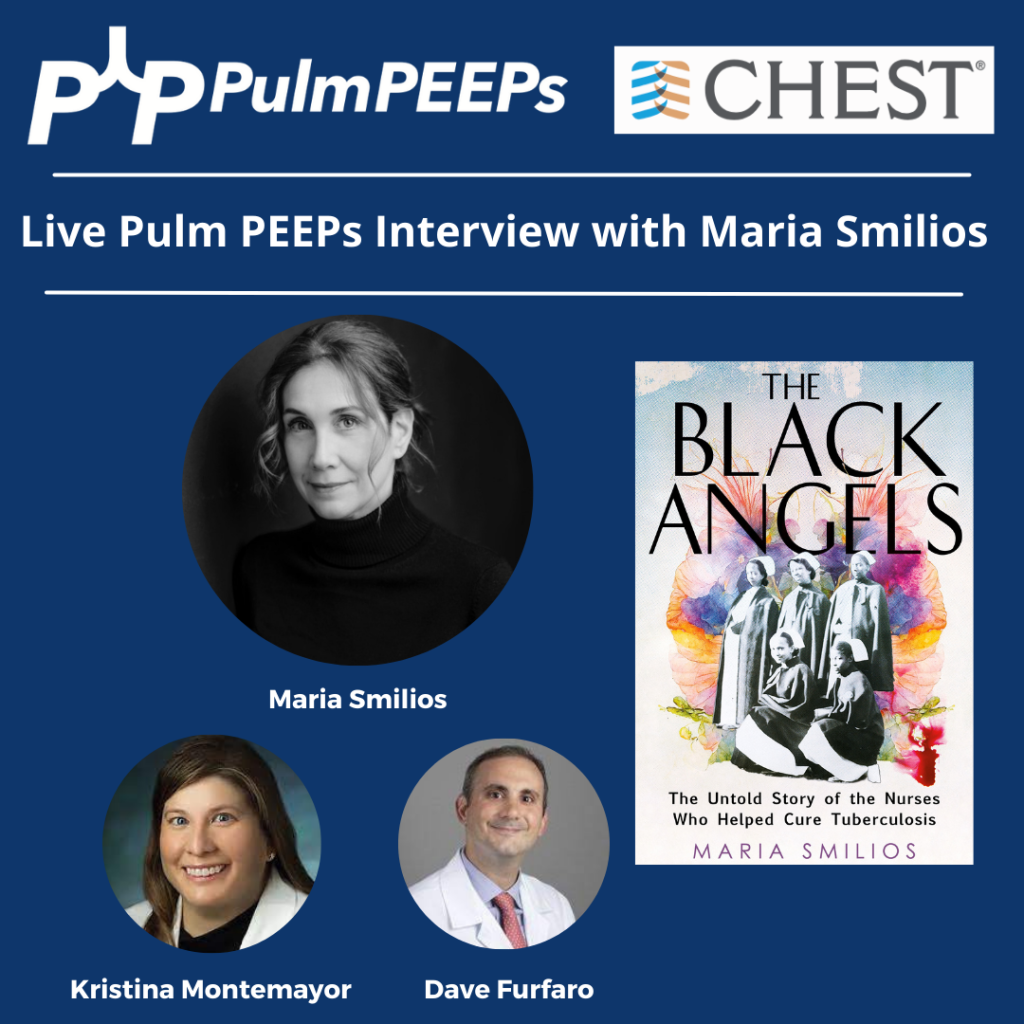
Here at Pulm PEEPs we have always loved the CHEST Annual Meetings. We have enjoyed learning at them, reuniting with and meeting colleagues, and having conference specific episodes the past two years. This year, we had the opportunity to podcast live at CHEST 2024 and it was a real thrill! We talked to Maria Smilios about her wonderful book The Black Angels: The Untold Story of the Nurses Who Helped Cure Tuberculosis. . The book covers a range of fascinating topics including how treatments for tuberculosis were developed, the successes and plights of Black nurses working in this endeavor, an exploration of health care in New York City, and a discussion of Racism and civil rights in American healthcare.
We were also thrilled that Virginia Allen, the last surviving Black Angel is at the conference and her and her colleagues (posthumously) are receiving an honorary FCCP.
Meet Our Guests
Maria Smiios is a native New Yorker but completed her master of arts in religion and literature right here in Boston. She completed her masters at Boston University, where she was a Luce scholar, and taught in the religion and writing program. Through her work, she found a love for history, medicine and women’s narratives. While working at Springer Publishing as a science book editor, she learned about the story of the Black Angels and was determined to tell their story. She spent years deeply engaged in the lives and stories of those who were closest to these remarkable women.
We are excited to be back with our colleagues from CHEST to be previewing the CHEST 2024 Annual Meeting. CHEST his year is in Boston, MA from October 5th to October 9th. Listen in to hear about some great new features at CHEST this year, some old favorites, and to learn how to optimize your conference experience. See you all in two weeks!
Meet Our Guests
Sandhya Khurana is a Professor of medicine at University of Rochester school of medicine and Director of the Mary Parkes Asthma Center. Her clinical and research interest is in asthma. She is the Vice-Program Chair for CHEST 2024 and will be the program Chair for CHEST 2025 next year in Chicago.
Gabe Bosslet is the Program Chair for CHEST this year. In addition he is a Professor of Clinical Medicine at Indiana University School of Medicine. He is also an Assistant Dean at IU, and the Director of Mentoring and Faculty Development for the Division Pulmonary, Critical Care, Allergy and Occupational Medicine.
Huzaifah Salat is a clinician educator who is currently working as a consultant pulmonologist and intensivist at Advocate Aurora Health in Wisconsin. He completed his Pulmonary and Critical Care Fellowship at the University of Oklahoma Health Sciences Center
Welcome to our second episode of ATS 2024 highlighting content featured through the ATS Critical Care Assembly. Today we are going to be talking about one of the Critical Care Assembly Symposiums entitled: “Care of Dying in the ICU: End of Life Care in 2024 and Beyond”
Meet our Guests
Dr. Theodore “Jack: Iwashyna is a Bloomberg Distinguished Professor at Johns Hopkins School of Medicine and the Johns Hopkins Bloomberg School of Public Health. Jack is a critical care physician and has a broad focus on research that understands the broader context of critical illness, and the long term impact on patients’ lives. He is an enormously productive and successful researcher with numerous publications in the field of critical care, and is a pioneer in the field of ICU survivorship. He is a devoted mentor and has received accolades from numerous societies
Dr. Molly Hayes is an Associate Professor of Medicine at Beth Israel Deaconess Medical Center and Harvard Medical School, the Director of the MICU at BIDMC, and the Director of External Education at the Carl J Shapiro Institute for Education and Research. She additionally is a co-founder of the BIDMC Center for Humanizing the ICU. Molly has been extensively involved with ATS with leadership roles in the Critical Care Assembly, and the newly minted Steering Committee on the Advancement of Learning.
Meet our Collaborators
The American Thoracic Society Critical Care Assembly is the largest Assembly in the American Thoracic Society. Their members include a diverse group of intensivists and care providers for both adult and pediatric critically ill patients. The primary goal of the Critical Care Assembly is to “improve the care of the critically ill through education, research, and professional development.”
Welcome to our first episode of ATS 2024 highlighting content featured through the ATS Critical Care Assembly. Today we are going to be talking about one of the Critical Care Assembly Symposiums entitled: “A New Reality for Critical Care after Dobbs.”
Meet our Guests
Dr. Katie Hauschildt is a Faculty Research Associate at The Johns Hopkins University School of Medicine where she conducts research on equity in healthcare and critical illness recovery. She has her PhD in Sociology from the University of Michigan and an Advanced Fellowship in Health Services Research from the VA Ann Arbor Healthcare System, and is a board certified patient advocate.
Dr. Kathleen Akgün is an Associate Profess or Medicine at the Yale School of Medicine. She is the Association Section Chief for the VA section of Pulmonary, the Co-Director of the Network of Dedicated Enrollment Sites Program, the director of the MICU at the VA Connecticut health care system, and a member of the DEI Working Group at Yale.
Meet our Collaborators
The American Thoracic Society Critical Care Assembly is the largest Assembly in the American Thoracic Society. Their members include a diverse group of intensivists and care providers for both adult and pediatric critically ill patients. The primary goal of the Critical Care Assembly is to “improve the care of the critically ill through education, research, and professional development.”
MacDonald A, Gershengorn HB, Ashana DC. The Challenge of Emergency Abortion Care Following the Dobbs Ruling. JAMA. 2022;328(17):1691-1692. doi:10.1001/jama.2022.17197
Ashana DC, Chen C, Hauschildt K, et al. The Epidemiology of Maternal Critical Illness Between 2008-2021. Ann Am Thorac Soc. Published online June 14, 2023. doi:10.1513/AnnalsATS.202301-071RL
Sonntag E, Akgun KM, Bag R, et al. Access to Medically Necessary Reproductive Care for Individuals with Pulmonary Hypertension. Am J Respir Crit Care Med. Published online June 13, 2023. doi:10.1164/rccm.202302-0230VP
Griffin KM, Oxford-Horrey C, Bourjeily G. Obstetric Disorders and Critical Illness. Clin Chest Med. 2022;43(3):471-488. doi:10.1016/j.ccm.2022.04.008
This week on Pulm PEEPs, we are excited to be cross-posting an episode that Dave Furfaro did on the ATS Breathe Easy Podcast. Listen to hear a discussion about the best way to create a positive learning environment in the ICU, and how to effectively prepare bedside teaching for learners of all levels.
Meet The Host
Matthew Stutz hosted this episode of the ATS Breathe Easy Podcast. He is an Attending Pulmonary and Critical Care physician at Cook County Health and an Assistant Professor at Rush University. He is a dedicated educator and an active member of the American Thoracic Society.
Key Learning Points
Empowerment: It’s crucial to empower both learners and teachers in an educational setting.
Open Communication: Learners should be encouraged to express their discomfort or challenges in learning. This will allow teachers to adapt and create a more effective learning environment.
Self-awareness and Continuous Improvement: Teachers should be self-aware and continuously strive for improvement. If a teacher knows their weak points or areas they want to enhance, such as bedside teaching or teaching on rounds, they should communicate this to their team. This will make the team more observant and supportive in giving feedback.
Honesty: A genuine and honest dialogue helps in building a strong and trusting educational relationship. It’s beneficial for both the teacher and learner to be candid about their needs and challenges.
Feedback Mechanism: Constructive feedback is an essential part of growth. By informing team members of areas you’re working on, you can receive specific and helpful feedback at the end of a rotation or session.
Appreciation: It’s important to appreciate and acknowledge contributions in an educational or collaborative setting.
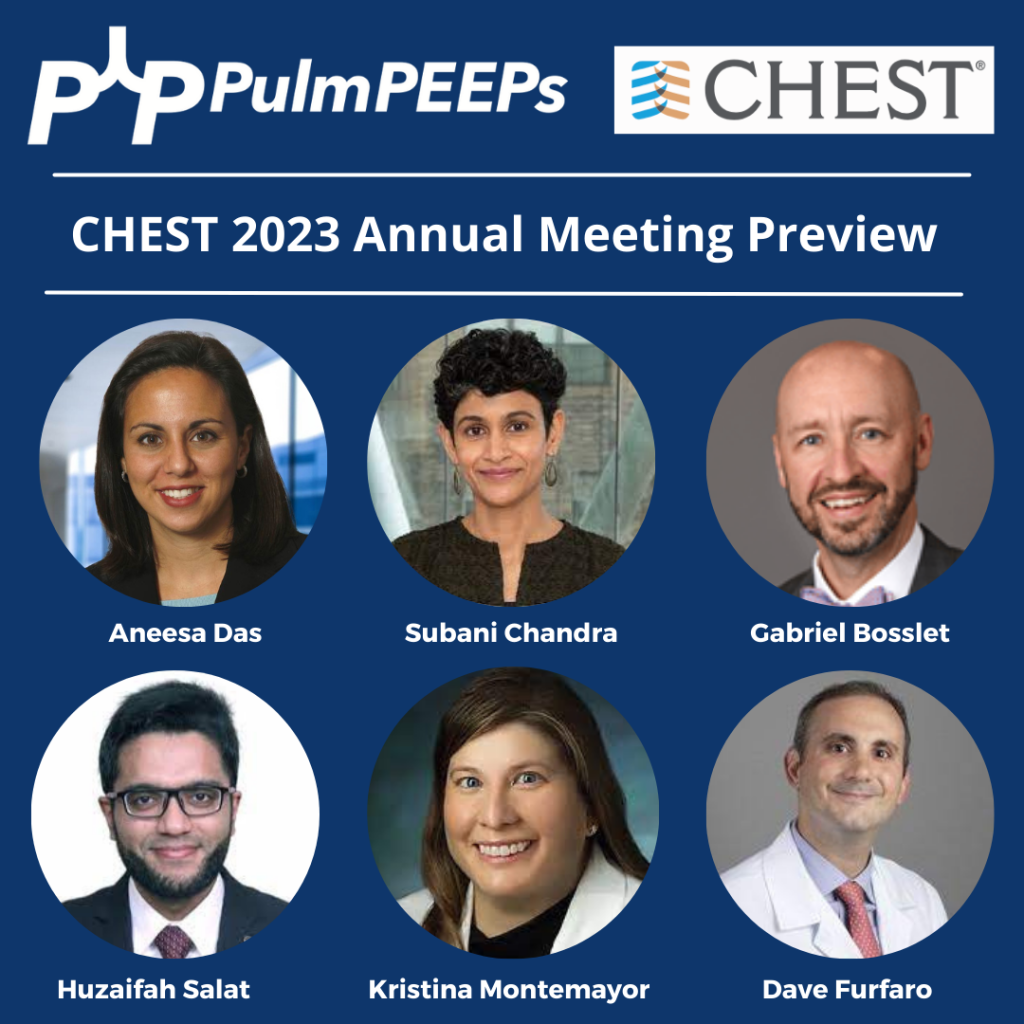
We are thrilled today to be previewing CHEST 2023! The Annual Meeting is taking place October 8th – 11th in Honolulu, Hawaii, and we are joined today by CHEST enthusiasts and the past, present, and future conference chairs. Listen now to hear what is in store for you next month in Hawaii, to plan your conference experience, and find out what sessions are can’t-miss!
Meet Our Guests
Aneesa Das is a Professor of Medicine at The Ohio State University Wexner Medical Center. She is the Assistant Director of the OSU Sleep Program and the Director of the Portable Sleep Testing Program. She was the Vice-Chair of the CHEST 2022 Scientific Programming Committee, and the Chair for 2023
Subani Chandra is an Associate Professor at Columbia University. She is the Vice Chair of Medicine for Education, and the internal medicine residency program director. She was the chair of the CHEST Scientific Program Committee for CHEST in 2022 and joined us when we came to you live from Nashville last year. Subani is currently the Chair for the Training and Transitions Committee for CHEST.
Gabe Bosslet is a Professor of Clinical Medicine in the Department of Pulmonary, Critical Care, Sleep and Occupational Medicine at Indiana University. He is the Assistant Dean for Faculty Affairs and Professional Development at IU. He is the current Vice Chair of the CHEST 2023 Scientific Programming Committee and the Chair Elect for CHEST 2024.
Huzaifah Salat is a budding clinician educator who is currently working as a consultant pulmonologist and intensivist at Advocate Aurora Health in Wisconsin. He recently completed his Pulmonary and Critical Care Fellowship at the University of Oklahoma Health Sciences Center. He has worked with Pulm PEEPs before on some fantastic Tweetorials.
CHEST’s Local Efforts and Initiatives to Support Survivors of the Maui Wildfires