79. RFJC 10 – ARDS Series – FACTT

In this podcast episode, we continue our summer series reviewing landmark ARDS studies. Today, Dave and Luke discuss the FACTT trial, which investigated fluid management strategies in ARDS. This was published in the NEJM in 2006.

Article and Reference

We’re talking about the FACTT trial today which was a “Comparison of Two Fluid-Management Strategies in Acute Lung Injury”

Reference: National Heart, Lung, and Blood Institute Acute Respiratory Distress Syndrome (ARDS) Clinical Trials Network; Wiedemann HP, Wheeler AP, Bernard GR, Thompson BT, Hayden D, deBoisblanc B, Connors AF Jr, Hite RD, Harabin AL. Comparison of two fluid-management strategies in acute lung injury. N Engl J Med. 2006 Jun 15;354(24):2564-75. doi: 10.1056/NEJMoa062200. Epub 2006 May 21. PMID: 16714767.

Infographic

Summary of discussion:

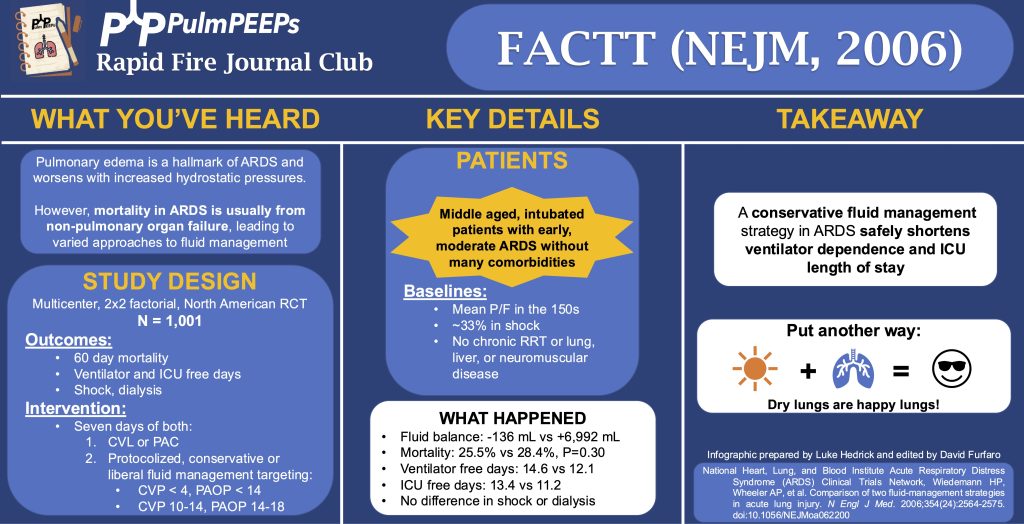
Background: The FACT trial aimed to address fluid balance in ARDS, given the complexity of managing pulmonary edema and systemic organ failure. The challenge has been finding the right balance between managing fluid to optimize cardiac function and avoiding exacerbation of pulmonary edema.

Study Design:

  • Randomized Controlled Trial: Conducted at 20 North American medical centers from 2000 to 2005.
  • Participants: Included intubated ARDS patients who required or were planned to receive a central venous catheter. Excluded patients with chronic diseases, recent MI, or irreversible conditions. Shock was not an exclusion criterion.
  • Interventions: Patients were randomly assigned to either a liberal or conservative fluid management strategy, and also received either a PA catheter or a central line.

Fluid Management Protocol:

  • Liberal Strategy: Aimed for higher filling pressures (CVP of 10-14 or wedge pressure of 14-18).
  • Conservative Strategy: Aimed for lower filling pressures (CVP less than 4 or wedge pressure under 14).
  • Fluid Balance: The liberal group had a net positive fluid balance of around 7 liters, while the conservative group had a net negative balance of about 130 cc.

    Results:

    • Mortality: No statistically significant difference in 60-day mortality between the liberal and conservative groups (25.5% vs. 28.4%, respectively).
    • Ventilator and ICU-Free Days: The conservative strategy resulted in more ventilator-free and ICU-free days.
    • Shock and Dialysis: There was no difference in shock rates, but the conservative group had a trend toward fewer dialysis requirements (10% vs. 14%, p=0.06).

    Conclusion: The trial indicated that a conservative fluid management strategy in ARDS patients can reduce ventilator dependence and ICU length of stay without worsening shock or end-organ function. It underscores the benefit of managing fluid conservatively to protect lung function, even though it didn’t significantly reduce mortality.

      Overall, the FACT trial supports the practice of conservative fluid management in ARDS, advocating that “dry lungs are happy lungs” for improving patient outcomes.

      78. PREOXI Trial

      Today, we’re going to be talking about pre-oxygenation methods for endotracheal intubation and the PREOXI Trial which is hot off the presses in the New England Journal of Medicine in June of 2024. This trial has potentially widespread, practice changing results and we’re lucky enough to be joined by two of the authors to discuss.


      Dr. Kevin Gibbs is an Associate Professor of Medicine at Wake Forest University School of Medicine. He obtained his MD at George Washington University School of Medicine, and completed his residency and fellowship training at Johns Hopkins. He is an active researcher in critical care, ARDS, mechanical ventilation, and pragmatic trial design.

      Dr. Jon Casey is an Assistant Professor of Medicine for the Division of Allergy, Pulmonary, and Critical Care Medicine at Vanderbilt University Medical Center. He obtained his MD from the University of Louisville School of Medicine, and completed his residency training at Brigham and Women’s Hospital before going to Vanderbilt for fellowship training. He is a physician scientist and also has his Masters of Science in Clinical Investigation. His research is focused on comparative effectiveness of ICU treatments and he also has a focus on pragmatic trials. He is supported with NIH funding and is active in the American Thoracic Society Critical Care Assembly.

      Summarized Key Points


      • Significance of the Problem: Tracheal intubation in emergency and ICU settings is common, with significant risks such as hypoxemia (10-20% incidence) and cardiac arrest (2% incidence) associated with the procedure. This makes effective pre-oxygenation crucial.

      • Methods of Pre-oxygenation: Common methods include face mask oxygen (e.g., non-rebreather, bag-mask devices) and more advanced techniques like non-invasive ventilation (used in about 15% of cases globally). Each method has pros (e.g., simplicity, no risk of aspiration for face masks; 100% oxygen delivery, positive pressure for non-invasive ventilation) and cons (e.g., potential for gastric insufflation with non-invasive ventilation).

      • Study Design: The study discussed in the podcast is a pragmatic trial aiming to optimize pre-oxygenation strategies to prevent peri-intubation hypoxemia. Eligibility criteria were broad, encompassing most patients undergoing tracheal intubation in the ED or ICU, with exclusions mainly for safety reasons.

      • Primary Outcome: The primary outcome of the trial was hypoxemia, defined as oxygen saturation < 85%. This threshold was chosen because it signifies a critical point on the oxygen dissociation curve, where patients are at higher risk of further desaturation and adverse outcomes.

      • Secondary Outcomes: Secondary exploratory outcomes included more severe levels of hypoxemia (oxygen saturation < 80% and < 70%), aiming to capture varying degrees of oxygenation failure during intubation. Rates of cardiac arrest during intubation were an additional outcome.

      • Intervention Comparison:

        • The trial compared two methods of pre-oxygenation: non-invasive ventilation (NIV) and oxygen mask (face mask)

        • Both methods aimed to provide at least three minutes of pre-oxygenation before intubation.

        • NIV group specifics: Expiratory pressure of 5 cm H2O, Inspiratory pressure of 10 cm H2O, respiratory rate of 10 breaths per minute, and 100% oxygen delivery

        • Oxygen mask group specifics: Non-rebreather or bag mask device with at least 15 liters per minute oxygen flow.

        • Nasal cannulas and HFNC could be used in both groups.


      • Logistics and Equipment Use:

        • The trial allowed flexibility in using available equipment (invasive ventilator capable of NIPPV vs. dedicated BiPAP machine).

        • Sites were encouraged to use the same ventilator for both pre-oxygenation and subsequent ventilation to streamline workflow and reduce logistical challenges.


      • Primary and Secondary Outcomes:

        • Results showed a significant reduction in hypoxemia incidents in the NIV group compared to the oxygen mask group.

        • There was also a reduction in severe hypoxemia and a notable decrease in cardiac arrest incidents in the NIV group.


      • Aspiration Safety:

        • There was no statistical difference in aspiration-related outcomes between the NIV and oxygen mask groups, indicating that NIV did not increase the risk of aspiration.


      • Conclusions:

        • The trial concluded that NIV for pre-oxygenation significantly reduced the incidence of hypoxemia and possibly cardiac arrest during tracheal intubation.

        • It also dispelled concerns about increased aspiration risk with NIPPV as pre-oxygenation, suggesting it can be safely used in clinical practice.


      Gibbs KW, Semler MW, Driver BE, Seitz KP, Stempek SB, Taylor C, Resnick-Ault D, White HD, Gandotra S, Doerschug KC, Mohamed A, Prekker ME, Khan A, Gaillard JP, Andrea L, Aggarwal NR, Brainard JC, Barnett LH, Halliday SJ, Blinder V, Dagan A, Whitson MR, Schauer SG, Walker JE Jr, Barker AB, Palakshappa JA, Muhs A, Wozniak JM, Kramer PJ, Withers C, Ghamande SA, Russell DW, Schwartz A, Moskowitz A, Hansen SJ, Allada G, Goranson JK, Fein DG, Sottile PD, Kelly N, Alwood SM, Long MT, Malhotra R, Shapiro NI, Page DB, Long BJ, Thomas CB, Trent SA, Janz DR, Rice TW, Self WH, Bebarta VS, Lloyd BD, Rhoads J, Womack K, Imhoff B, Ginde AA, Casey JD; PREOXI Investigators and the Pragmatic Critical Care Research Group. Noninvasive Ventilation for Preoxygenation during Emergency Intubation. N Engl J Med. 2024 Jun 20;390(23):2165-2177. doi: 10.1056/NEJMoa2313680. Epub 2024 Jun 13. PMID: 38869091.

      77. RFJC 9 – ARDS Series – ARMA

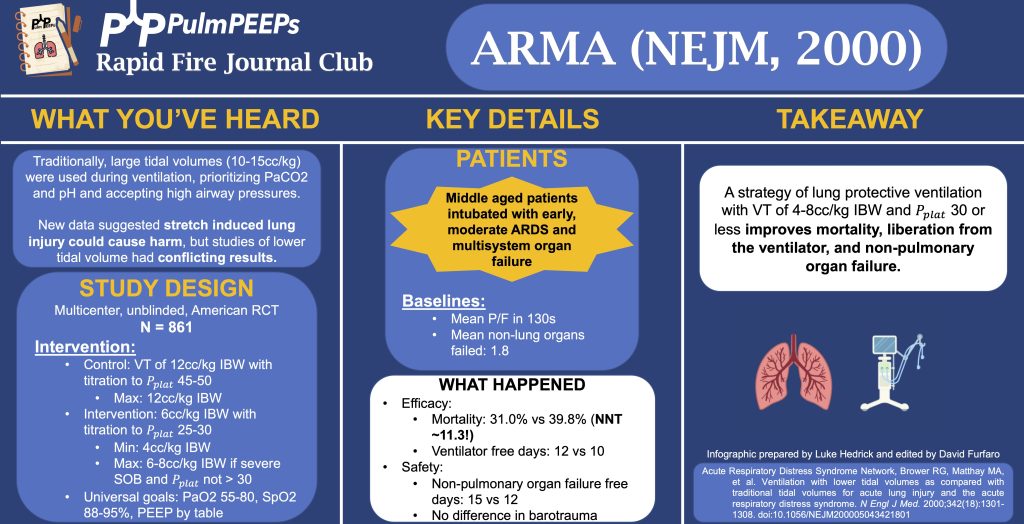
      This episode is launching our 2024 Rapid Fire Journal Club summer series on ARDS! This summer we will be talking about landmark ARDS trials that have defined the literature and shaped patient care. Journal clubs often focus on new trials, and so learners may have a less thorough understanding of the baseline literature that defines many of our ICU practices. The goal of this series is to provide a quick, but in-depth look at these papers so that learners understand the modern landscape of ARDS.

      Today, we’re kicking this initiative off by looking at the ARMA or ARDSNet Trial published in the NEJM in 2000. Enjoy!

      Article and Reference

      We’re talking about the ARMA trial today which examined “Ventilation with Lower Tidal Volumes as Compared with Traditional Tidal Volumes for Acute Lung Injury and the Acute Respiratory Distress Syndrome.”

      Reference: Acute Respiratory Distress Syndrome Network; Brower RG, Matthay MA, Morris A, Schoenfeld D, Thompson BT, Wheeler A. Ventilation with lower tidal volumes as compared with traditional tidal volumes for acute lung injury and the acute respiratory distress syndrome. N Engl J Med. 2000 May 4;342(18):1301-8. doi: 10.1056/NEJM200005043421801. PMID: 10793162.

      Infographic

      Correction:

      We mention a step-wise titration of tidal volume in the control group to achieve Pplats of 45-50. To clarify, there was no adjustment of Vt in the traditional Vt group unless Pplat > 50. If Vt had been decreased in the traditional Vt group because Pplat was > 50, it would not be subsequently increased back to 12 unless Pplat < 45 (to avoid a cycle of corrections and re-adjustments). Similarly in the lower Vt group, there was no adjustment (“titration”) of Vt unless Pplat > 30, and there was a similar protocol in place not to increase the Vt again unless the Pplat was < 25.

      75. Rapid Fire Journal Club 8 – STELLAR

      We’re back with our Rapid Fire Journal Club, and talking about the NEJM 2023 STELLAR Trial of Sotatercept in Pulmonary Arterial Hypertension. This is a landmark trial that is actively changing the face of PAH treatment today. Listen to hear the details of the trial and how its findings can be utilized to help patients.

      Article and Reference

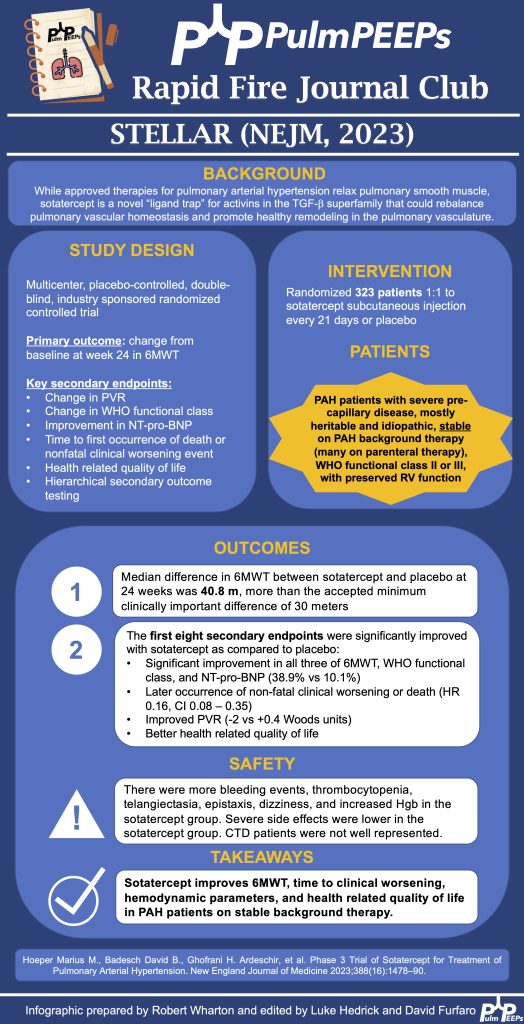
      We’re looking at the STELLAR Trial today which is a Phase 3 trial of Sotatercept in Pulmonary Arterial Hypertension.

      Reference: Hoeper MM, Badesch DB, Ghofrani HA, Gibbs JSR, Gomberg-Maitland M, McLaughlin VV, Preston IR, Souza R, Waxman AB, Grünig E, Kopeć G, Meyer G, Olsson KM, Rosenkranz S, Xu Y, Miller B, Fowler M, Butler J, Koglin J, de Oliveira Pena J, Humbert M; STELLAR Trial Investigators. Phase 3 Trial of Sotatercept for Treatment of Pulmonary Arterial Hypertension. N Engl J Med. 2023 Apr 20;388(16):1478-1490. doi: 10.1056/NEJMoa2213558. Epub 2023 Mar 6. PMID: 36877098.

      Infographic

      69. Rapid Fire Journal Club 7 – SMART Meta-Analysis

      Today on Rapid Fire Journal Club we’re reviewing a new article type and discussing a meta-analysis of Single Maintenance and Reliever Therapy (SMART) for asthma.

      Article and Reference

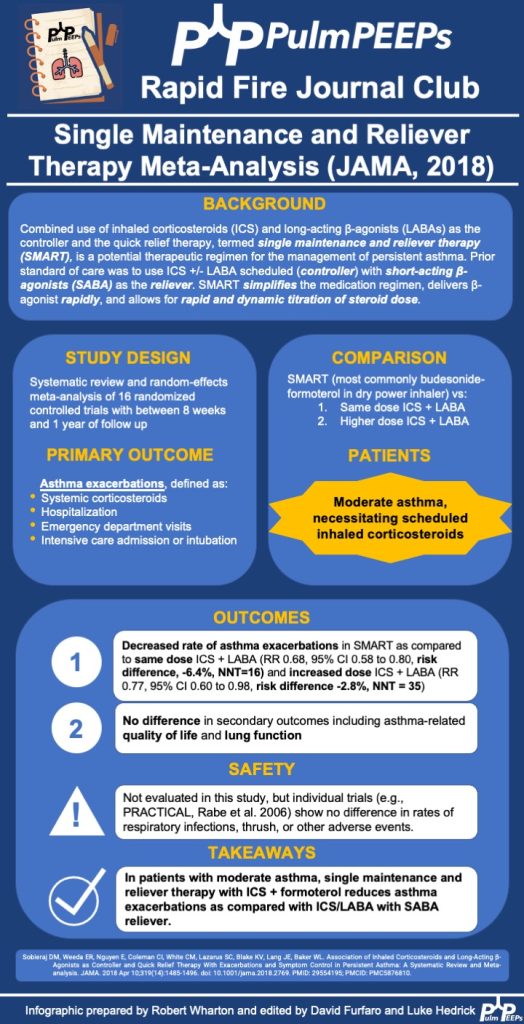
      Today we’re taking a deeper diver into SMART treatment for asthma to continue our discussion of inhalers.

      Reference: Sobieraj DM, Weeda ER, Nguyen E, Coleman CI, White CM, Lazarus SC, Blake KV, Lang JE, Baker WL. Association of Inhaled Corticosteroids and Long-Acting β-Agonists as Controller and Quick Relief Therapy With Exacerbations and Symptom Control in Persistent Asthma: A Systematic Review and Meta-analysis. JAMA. 2018 Apr 10;319(14):1485-1496. doi: 10.1001/jama.2018.2769. PMID: 29554195; PMCID: PMC5876810.

      Infographic

      65. Rapid Fire Journal Club 6 – SARCORT Trial

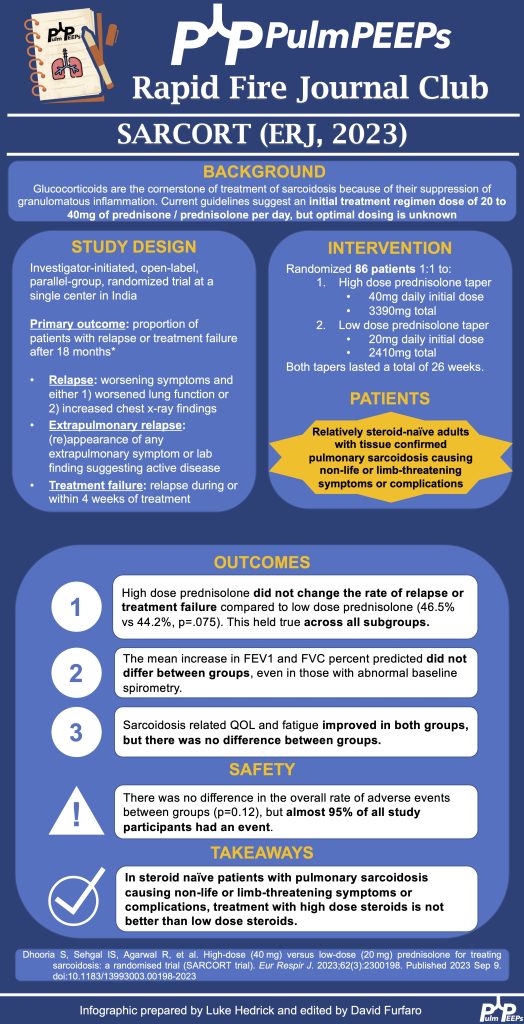
      Today we’re continuing our Rapid Fire Journal Club series. We’ve mainly been discussing landmark trials, but today we’re delving into a new study with interesting findings that are applicable to a common presentation in pulmonary medicine: treatment naive sarcoidosis. We’re discussing the SARCORT trial published in the European Respiratory Journal in 2023. This study evaluated a high vs low dose steroid trial in patients with sarcoidosis. Pulm PEEPs Associate Editor Luke Hedrick walks us through the study.

      Article and Reference

      Today we’re discussing the 2023 SARCORT Trial published in the European Respiratory Journal.

      Reference: Dhooria S, Sehgal IS, Agarwal R, Muthu V, Prasad KT, Dogra P, Debi U, Garg M, Bal A, Gupta N, Aggarwal AN. High-dose (40 mg) versus low-dose (20 mg) prednisolone for treating sarcoidosis: a randomised trial (SARCORT trial). Eur Respir J. 2023 Sep 9;62(3):2300198. doi: 10.1183/13993003.00198-2023. PMID: 37690784.

      Infographic

      This can be downloaded on our website and will be shared on Twitter and Instagram.

      63. Rapid Fire Journal Club 5 – Novel START

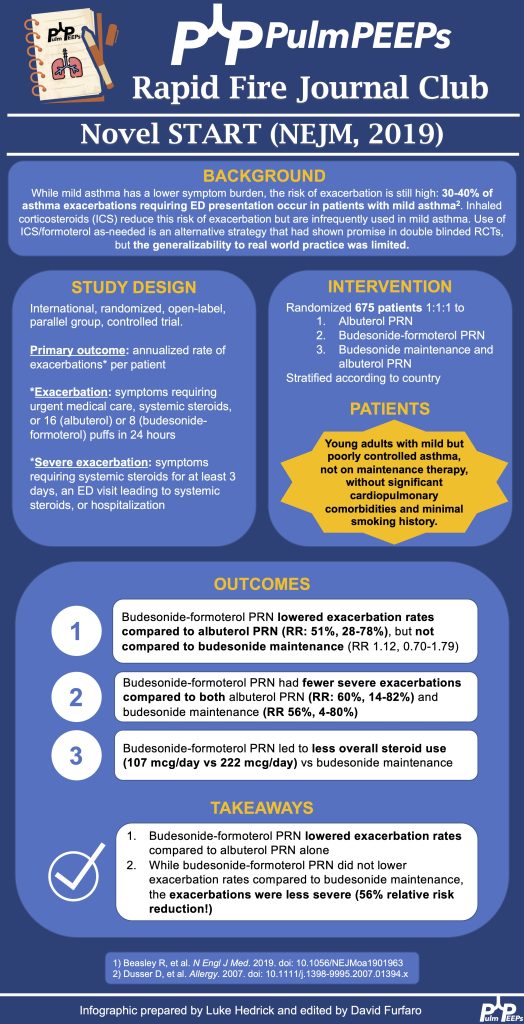
      Today on our Rapid Fire Journal Club series, we’re discussing the Novel START study published in the NEJM in 2019. This study evaluated multiple strategies for the management of mild asthma with exacerbations, and it guides our current therapeutic approach. Pulm PEEPs Associate Editor Luke Hedrick walks us through the study. If you take care of asthma patients, be it in a primary care clinic, pulmonary clinic, or the hospital, make sure to listen in!

      Article and Reference

      Today we’re discussing the 2019 Novel START Study published in NEJM

      Reference: Beasley R, Holliday M, Reddel HK, Braithwaite I, Ebmeier S, Hancox RJ, Harrison T, Houghton C, Oldfield K, Papi A, Pavord ID, Williams M, Weatherall M; Novel START Study Team. Controlled Trial of Budesonide-Formoterol as Needed for Mild Asthma. N Engl J Med. 2019 May 23;380(21):2020-2030. doi: 10.1056/NEJMoa1901963. Epub 2019 May 19. PMID: 31112386.

      Infographic

      This can be downloaded on our website and will be shared on Twitter and Instagram.

      60. Rapid Fire Journal Club 4 – The Lung Health Study

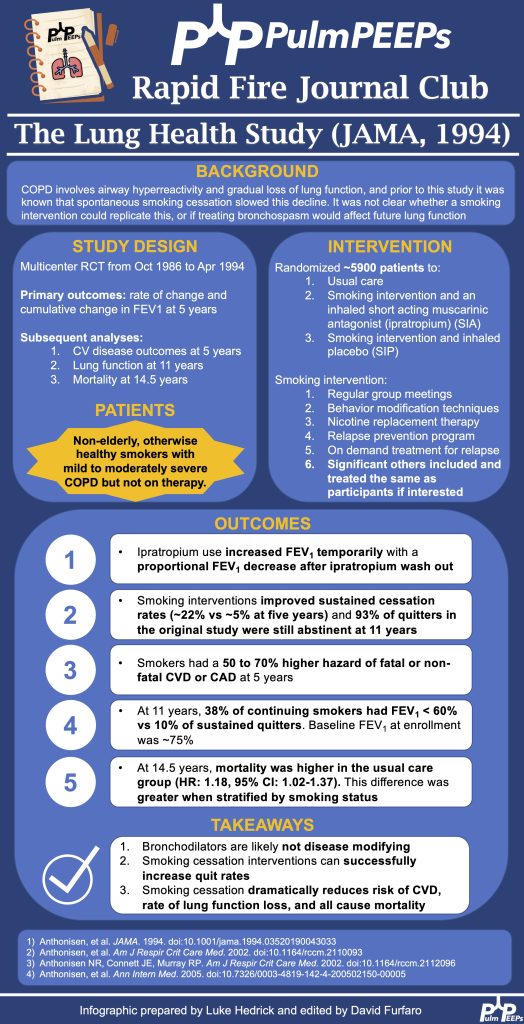
      This week for our Rapid Fire Journal Club we’re talking about The Lung Health Study published in 1994 in JAMA. This study evaluates the impact of smoking cessation and short-acting bronchodilators on the decline of lung health. Pulm PEEPs Associate Editor Luke Hedrick returns to walk through the analysis of this study.

      Article and Reference

      Today we’re talking about the 1994 Lung Health Study from JAMA

      Reference: Anthonisen NR, Connett JE, Kiley JP, Altose MD, Bailey WC, Buist AS, Conway WA Jr, Enright PL, Kanner RE, O’Hara P, et al. Effects of smoking intervention and the use of an inhaled anticholinergic bronchodilator on the rate of decline of FEV1. The Lung Health Study. JAMA. 1994 Nov 16;272(19):1497-505. PMID: 7966841.

      Infographic

      This can be downloaded on our website and will be shared on Twitter and Instagram.

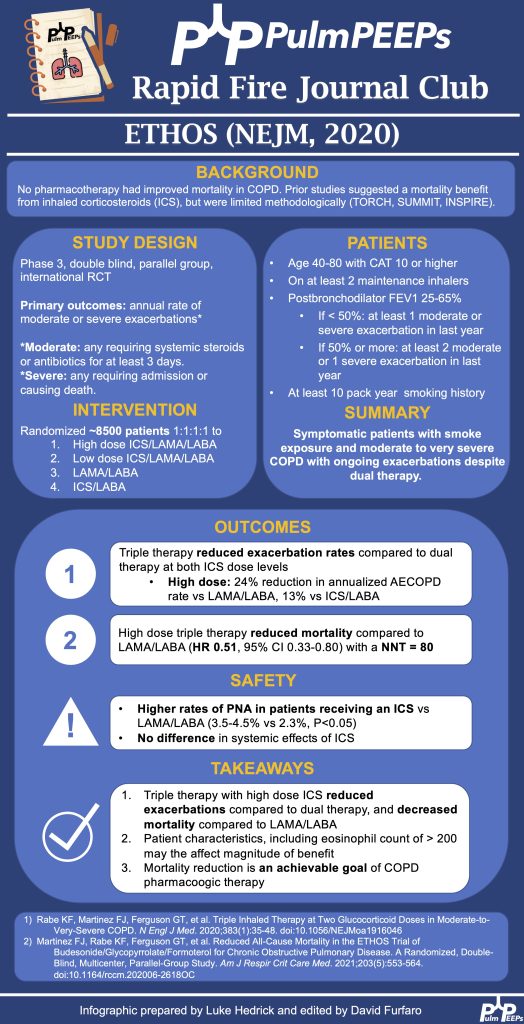
      57. Rapid Fire Journal Club 3 – ETHOS

      Rapid Fire Journal Club returns with a deep dive into the 2020 ETHOS Trial published in The New England Journal of Medicine examining triple therapy for moderate to severe COPD. Pulm PEEPs Associate Editor Luke Hedrick takes us through this fascinating study and breaks down some of the intricacies.

      Article and Reference

      Today we’re talking about the 2020 ETHOS Trial in NEJM

      Reference: Rabe KF, Martinez FJ, Ferguson GT, Wang C, Singh D, Wedzicha JA, Trivedi R, St Rose E, Ballal S, McLaren J, Darken P, Aurivillius M, Reisner C, Dorinsky P; ETHOS Investigators. Triple Inhaled Therapy at Two Glucocorticoid Doses in Moderate-to-Very-Severe COPD. N Engl J Med. 2020 Jul 2;383(1):35-48. doi: 10.1056/NEJMoa1916046. Epub 2020 Jun 24. PMID: 32579807.

      Infographic

      This can be downloaded on our website and will be shared on Twitter and Instagram.

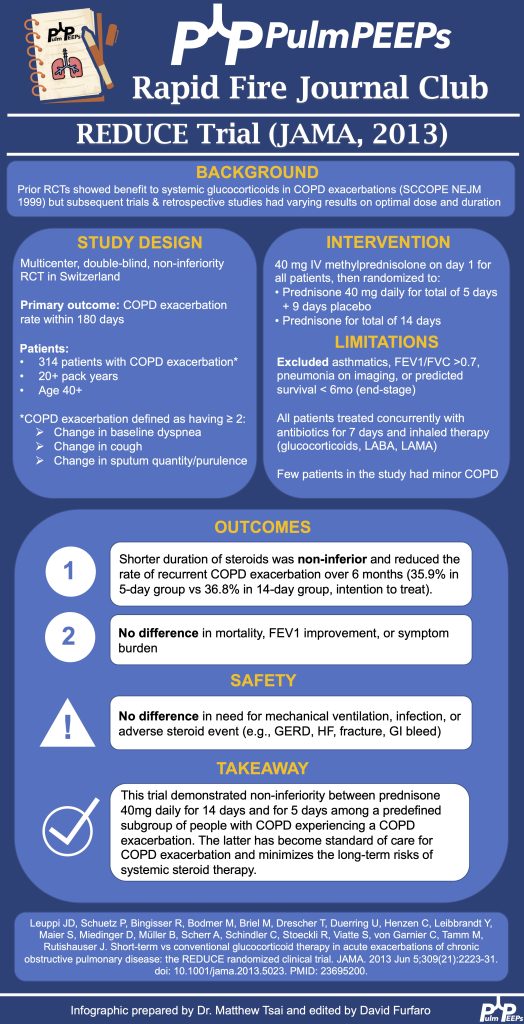
      50. Rapid Fire Journal Club 2 – REDUCE Trial

      We’re back with our second episode of our Rapid Fire Journal Club. As a reminder, we will be reviewing articles in 10 minutes or less and sharing them with an infographic describing the findings of the trial. We are focusing on pulmonary trials to start.

      Article and Reference

      Today we’re talking about the 2013 REDUCE Trial in JAMA.

      Reference: Leuppi JD, Schuetz P, Bingisser R, Bodmer M, Briel M, Drescher T, Duerring U, Henzen C, Leibbrandt Y, Maier S, Miedinger D, Müller B, Scherr A, Schindler C, Stoeckli R, Viatte S, von Garnier C, Tamm M, Rutishauser J. Short-term vs conventional glucocorticoid therapy in acute exacerbations of chronic obstructive pulmonary disease: the REDUCE randomized clinical trial. JAMA. 2013 Jun 5;309(21):2223-31. doi: 10.1001/jama.2013.5023. PMID: 23695200.

      Infographic

      This can be downloaded on our website and will be shared on Twitter and Instagram.