105. ICU Acquired Weakness

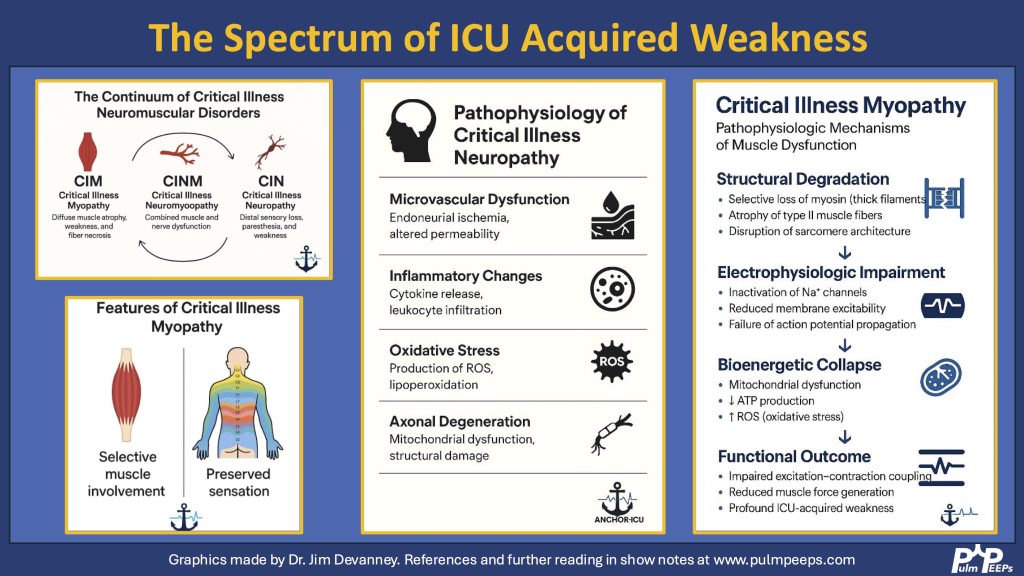
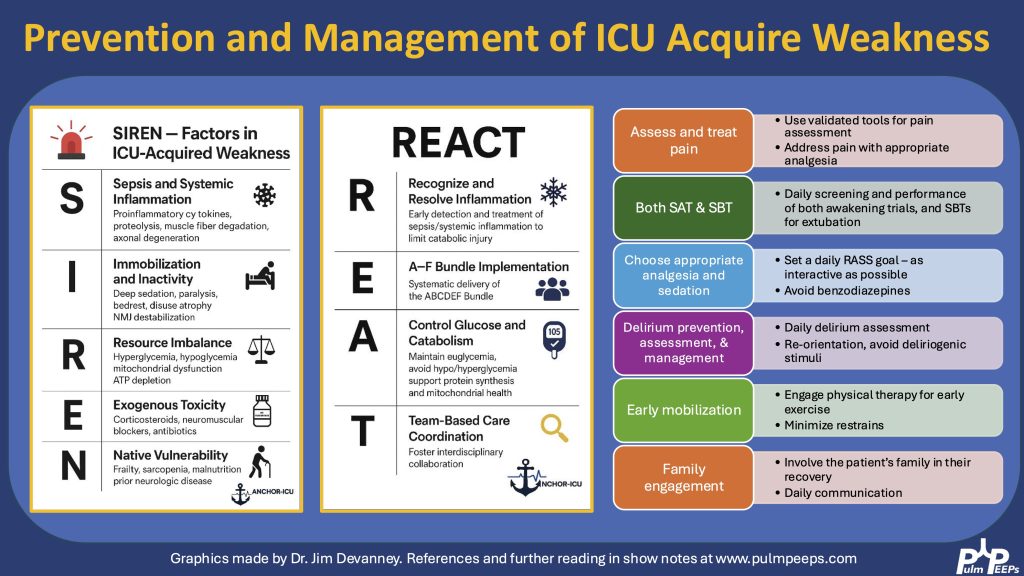
Today we’re talking about a topic that is relevant for all critical care physicians but under-examined: ICU Acquired Weakness. We are joined by two excellent guests to walk through a case and discuss the diagnosis, pathophysiology, prevention, and treatment of ICU Acquired Weakness. Check out our associated infographics and key learning points below.

Definition & Clinical Presentation

  • ICU-AW refers to new-onset, generalized muscle weakness that arises during critical illness, not explained by other causes.It typically presents as:
    • Symmetric, proximal > distal weaknessRespiratory muscle involvementPreserved cranial nerve functionNo sensory deficits in myopathy (sensory loss points toward neuropathy)
  • Differential Diagnosis Using Neuroanatomical ApproachAn anatomical approach (central → peripheral) helps localize the etiology weakness
  • CNS: trauma, stroke, encephalitis, seizuresAnterior horn cells: viral myelitis, motor neuron diseasePeripheral nerves: Guillain-Barré, vasculitis, critical illness polyneuropathy (CIP)Neuromuscular junction: myasthenia gravis, botulism, Lamber EatonMuscle: rhabdomyolysis, inflammatory or drug-induced myopathies, critical illness myopathy (CIM)
  • Subtypes of ICU-AW
  • Critical Illness Myopathy (CIM):
    • Muscle dysfunctionEarly onset (within 48 hrs)Sensation intactproximal > distal weakness

  • Critical Illness Polyneuropathy (CIP):
    • Nerve involvementDistal > proximal weakness, sensory deficits
    • Critical Illness Polyneuromyopathy (CIPNM): Combination of both

    Diagnosis

    • Medical Research Council Score (MRC-SS):
      • Score < 48: ICU-AW
      • Score < 36: severe ICU-AW
    • Handgrip dynamometry: <11 kg (men), <7 kg (women)
    • Electrophysiology: EMG/NCS to distinguish CIM vs CIP
    • Muscle ultrasound: bedside monitoring
    • MRI/CT/Muscle biopsy: rarely used due to practical limitation

    Risk Factors

    Modifiable:

    • Hyper/hypoglycemia
    • Electrolyte derangement
    • Parenteral nutrition
    • Immobility
    • Medications (steroids, NM blockers, sedatives, aminoglycosides)

    Non-modifiable:

    • Age, female sex, comorbidities
    • Severity of illness, prolonged ventilation
    • Sepsis, multi-organ failure

     Management & Prevention

    • Prevention is key:
      • Early treatment of sepsis and inflammation
      • Glycemic control
      • Early enteral nutrition
      • Minimize sedation (A-F bundle)
      • Early mobilization and physical therapy
    • NMES (neuromuscular electrical stimulation): emerging therapy, needs more evidence

    Outcomes

    • Short-term: increased LOS, ventilation duration, mortality
    • Long-term: decreased function, discharge to rehab, prolonged recovery

    Final Takeaways

    • Prevention is crucial — start interventions early.
    • Systematic approach to ICU weakness helps rule out dangerous mimics.
    • ICU-AW is common but often under-recognized — awareness and early rehab can significantly impact recovery.


    Clinical Practice Guidelines for the Prevention and Management of Pain, Agitation/­Sedation, Delirium, Immobility, and Sleep Disruption in Adult Patients in the ICU.
    Devlin JW, Skrobik Y, Gélinas C, et al. Critical Care Medicine. 2018;46(9):e825-e873. doi:10.1097/CCM.0000000000003299.

    The ABCDEF Bundle: Science and Philosophy of How ICU Liberation Serves Patients and Families. Ely EW. Critical Care Medicine. 2017;45(2):321-330. doi:10.1097/CCM.0000000000002175.

    Caring for Critically Ill Patients With the ABCDEF Bundle: Results of the ICU Liberation Collaborative in Over 15,000 Adults. Pun BT, Balas MC, Barnes-Daly MA, et al. Critical Care Medicine. 2019;47(1):3-14. doi:10.1097/CCM.0000000000003482.

    Delirium in Critical Illness: Clinical Manifestations, Outcomes, and Management. Stollings JL, Kotfis K, Chanques G, et al. Intensive Care Medicine. 2021;47(10):1089-1103. doi:10.1007/s00134-021-06503-1.

    ICU-acquired Weakness. Vanhorebeek I, Latronico N, Van den Berghe G. Intensive Care Medicine. 2020;46(4):637-653. doi:10.1007/s00134-020-05944-4.

    Clinical Review: Intensive Care Unit Acquired Weakness. Hermans G, Van den Berghe G. Critical Care (London, England). 2015;19:274. doi:10.1186/s13054-015-0993-7.

    Best Practices for Conducting Interprofessional Team Rounds to Facilitate Performance of the ICU Liberation (ABCDEF) Bundle. Stollings JL, Devlin JW, Lin JC, et al. Critical Care Medicine. 2020;48(4):562-570. doi:10.1097/CCM.0000000000004197.

    ABCDE and ABCDEF Care Bundles: A Systematic Review of the Implementation Process in Intensive Care Units. Moraes FDS, Marengo LL, Moura MDG, et al. Medicine. 2022;101(25):e29499. doi:10.1097/MD.0000000000029499.

    21. Post Intensive Care Syndrome (PICS)

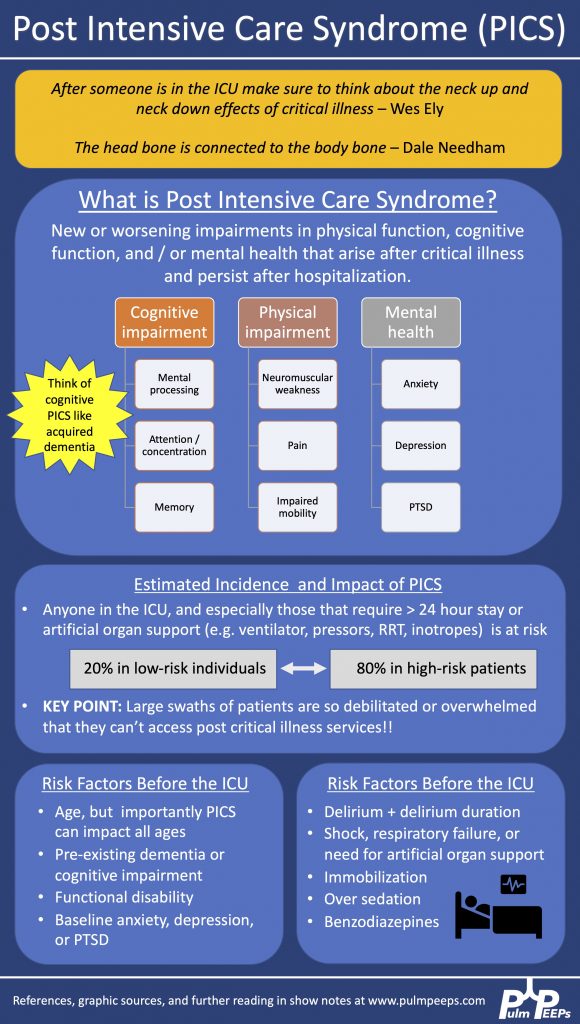
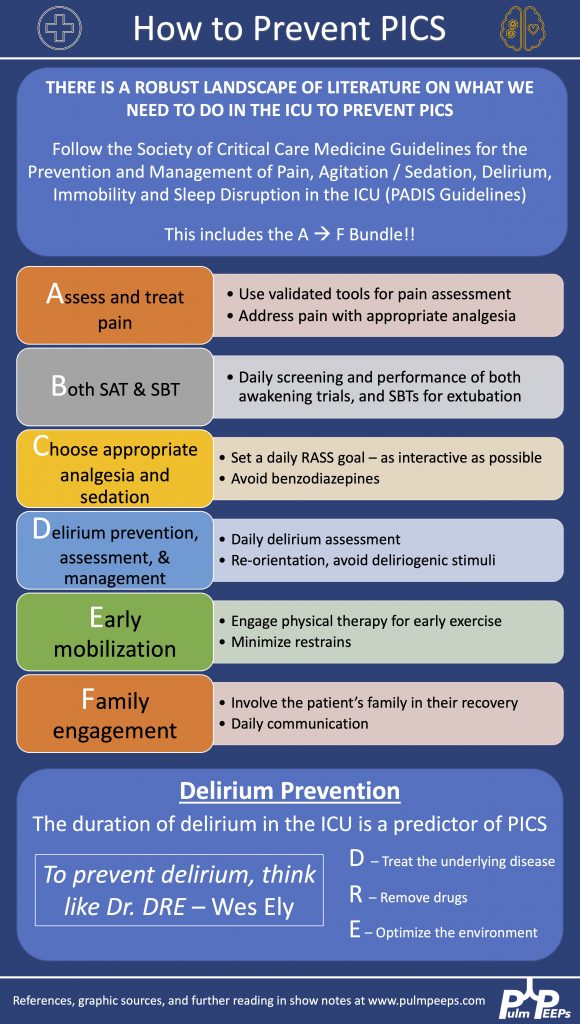
    Today on Pulm PEEPs, we are joined by two pioneers in the field of post-intensive care outcomes and delirium research. Drs. Dale Needham and Wes Ely talk to us all about the Post Intensive Care Syndrome (PICS) and cover everything from how it was first recognized, to the impact it has, and, most importantly, what we can do to prevent it. This is a huge topic in the field of critical care and we’re thrilled to be delving into it with such knowledgeable guides.

    Meet Our Guests

    Wes Ely is the Grant W. Liddle Chair in Medicine and a Professor of Medicine at Vanderbilt University Medical Center. He is also the Associate Director of Aging Research at the VA Tennessee Valley Geriatric Research and Education Clinical Center and the co-director of the Critical, Illness, Brain Dysfunction and Survivorship Center. He has published 100s of manuscripts on critical illness survivorship and delirium. He also published a book called “Every Deep-Drawn Breath” about his and his patients’ experiences in the ICU and about the ramifications of critical illness. All net proceeds for the book are going to the CIBS Center Endowment for Survivorship

    Dale Needham is a Professor of Medicine at Johns Hopkins, where he is also the Medical Director of the Critical Care Physical Medicine and Rehabilitation Program and the Director of the Outcomes After Critical Illness and Surgery Group. He is the author of 100s of publications focusing on post-ICU outcomes and has received numerous research grants from the NIH and other organizations.

    Key Learning Points

    Visit our website www.pulmpeeps.com to see the key learning points from this episode summarized in two infographics.

    References and links for further reading

    1. Devlin JW, Skrobik Y, Gélinas C, et al. Executive Summary: Clinical Practice Guidelines for the Prevention and Management of Pain, Agitation/Sedation, Delirium, Immobility, and Sleep Disruption in Adult Patients in the ICU. Critical Care Medicine. 2018;46(9):1532-1548. doi:10.1097/CCM.0000000000003259
    2. Ely EW. The ABCDEF Bundle: Science and Philosophy of How ICU Liberation Serves Patients and Families. Crit Care Med. 2017;45(2):321-330. doi:10.1097/CCM.0000000000002175
    3. Mikkelsen ME, Still M, Anderson BJ, et al. Society of Critical Care Medicine’s International Consensus Conference on Prediction and Identification of Long-Term Impairments After Critical Illness. Crit Care Med. 2020;48(11):1670-1679. doi:10.1097/CCM.0000000000004586
    4. Needham DM, Sepulveda KA, Dinglas VD, et al. Core Outcome Measures for Clinical Research in Acute Respiratory Failure Survivors. An International Modified Delphi Consensus Study. Am J Respir Crit Care Med. 2017;196(9):1122-1130. doi:10.1164/rccm.201702-0372OC
    5. Needham DM, Wozniak AW, Hough CL, et al. Risk Factors for Physical Impairment after Acute Lung Injury in a National, Multicenter Study. Am J Respir Crit Care Med. 2014;189(10):1214-1224. doi:10.1164/rccm.201401-0158OC
    6. Semler MW, Bernard GR, Aaron SD, et al. Identifying Clinical Research Priorities in Adult Pulmonary and Critical Care. NHLBI Working Group Report. Am J Respir Crit Care Med. 2020;202(4):511-523. doi:10.1164/rccm.201908-1595WS
    7. Spruit MA, Holland AE, Singh SJ, Tonia T, Wilson KC, Troosters T. COVID-19: Interim Guidance on Rehabilitation in the Hospital and Post-Hospital Phase from a European Respiratory Society and American Thoracic Society-coordinated International Task Force. Eur Respir J. Published online August 13, 2020:2002197. doi:10.1183/13993003.02197-2020
    8. Turnbull AE, Sepulveda KA, Dinglas VD, Chessare CM, Bingham CO, Needham DM. Core Domains for Clinical Research in Acute Respiratory Failure Survivors: An International Modified Delphi Consensus Study. Crit Care Med. 2017;45(6):1001-1010. doi:10.1097/CCM.0000000000002435
    9. Ward DS, Absalom AR, Aitken LM, et al. Design of Clinical Trials Evaluating Sedation in Critically Ill Adults Undergoing Mechanical Ventilation: Recommendations From Sedation Consortium on Endpoints and Procedures for Treatment, Education, and Research (SCEPTER) Recommendation III. Crit Care Med. 2021;49(10):1684-1693. doi:10.1097/CCM.0000000000005049
    10. Ozga D, Krupa S, Witt P, Mędrzycka-Dąbrowska W. Nursing Interventions to Prevent Delirium in Critically Ill Patients in the Intensive Care Unit during the COVID19 Pandemic—Narrative Overview. Healthcare. 2020;8:578. doi:10.3390/healthcare8040578