121. My Diagnosis

Hey everyone, Dave Furfaro here from Pulm PEEPs. As you may have noticed in the last few weeks and months, we’ve had a little bit of a decrease in the content that we’ve been putting out, and I just wanted to share a couple things with you about why that is and the future of Pulm PEEPs coming up. In December of 2025, I was diagnosed with a large myxoid liposarcoma in my leg, and since then, I have been undergoing treatment for that.

Overall, treatment has been going well, but it’s certainly been a long road that, continues, and I hope that it continues to trend positively. Kristina has been an unbelievable support during this. We have continued to work on some content as a great way and distraction for me at times, but we haven’t been able to keep up the same pace of content that we usually put out. And given everything that is going on, I actually anticipate that will continue for a few months. Ee haven’t said anything so far yet because we were still figuring it out ourselves, but now we just wanted you all to know that, we, love doing Pulm PEEPs. We’re very committed to it. We wanna get back to doing it as consistently as we have been previously, and we plan on doing that, but it likely will be a little bit of time, and this is why.

I also may be sharing more about my journey through the medical system as a patient, in the future, but for now, I’m really just focusing on my treatment, my health, and my family. So the summer months will likely be, much slower, maybe even a break off together, and look forward to recovering and getting back to producing more regular Pulm PEEPs content in the Fall.

Hope everybody who’s listening is doing well. Thank you all, as always, for being supportive, for listening to the podcast, for reaching out to us on social media, for saying hi to us in person at conferences. It’s been, a true delight, and we can’t wait to get back to business as usual. Okay, everybody. Take good care of patients, be safe, be well, and we’ll see you soon.

94. The Impact of Reduced NIH Indirect Cost Payments

On February 7, 2025 it was announced that the National Institutes of Health (NIH) would be capping indirect cost payments for research grants at 15%. This is a massive reduction from the current standard, and will have widespread impacts on research, healthcare delivery, and trainee and young faculty development throughout the United States. We have a special episode today to try to explain what this change really means, the broad impact it will have on the healthcare system and scientific research, and what we as a the healthcare community can / should be doing. Please feel free to reach out to us with any thoughts or questions from the episode.

Dr. Theodore “Jack” Iwashyna is a Bloomberg Distinguished Professor at Johns Hopkins School of Medicine and the Johns Hopkins Bloomberg School of Public Health. Jack is a critical care physician and focuses on research to understand the broader context of critical illness, and the long term impact on patients’ lives. He is an enormously productive and successful researcher with numerous publications in the field of critical care, and is a pioneer in the field of ICU survivorship. He is a devoted mentor and has received accolades from numerous societies

Dr. Kathryn Hibbert is an Assistant Professor of Medicine at Harvard Medical School and a pulmonary and critical care physician at Massachusetts General Hospital. She is the MICU Director at MGH, as well at the Vice Chair for Critical Care.

  1. Overview of NIH Funding
    • NIH research funding is divided into direct costs (salaries, supplies, specific project expenses) and indirect costs (infrastructure, utilities, administrative support).
    • Indirect costs support shared research resources like lab space, IT infrastructure, and institutional overhead.
  2. Recent Policy Change & Impact
    • A sudden 15% cap on indirect cost reimbursement for NIH grants was announced late on a Friday, catching the academic community off guard.
    • Many universities typically receive 50-60% in indirect cost reimbursements, making this a drastic cut.
    • This change could severely affect research institutions by reducing available funding for shared infrastructure, education, and clinical care.
  3. Broader Ramifications
    • Threat to Medical Research: Loss of funding for essential research infrastructure could slow or halt key medical advancements, such as cancer therapies, CF treatments, and more.
    • Impact on Education & Clinical Care: Reduced research funding could lead to cuts in trainee programs, fewer job opportunities, and diminished support for clinical services, particularly those serving vulnerable populations.
    • Economic Consequences: Academic medical centers are often major employers in states across the U.S. A reduction in funding could lead to job losses and economic downturns in affected regions.
  4. Political and Institutional Response
    • Legal challenges were quickly filed, resulting in a temporary restraining order against the policy change.
    • The administration’s actions were seen as an attack on academic freedom and scientific independence.
    • The impact extends beyond select universities or states. States like Texas, Ohio, Florida, and Iowa stand to lose millions in research funding.
  5. Advice for Early-Career Researchers
    • Continue applying for NIH grants as normal, following institutional guidance.
    • Stay informed about evolving policies.
    • Engage in advocacy—contact representatives, raise awareness, and contribute to public discussions.
  6. Call to Action
    • The speakers urge medical professionals, researchers, and the public to share knowledge about what the impact of these changes would be, and prevent them from becoming permanent.
    • They emphasize the critical role of NIH-funded research in improving healthcare outcomes worldwide and encourage continued engagement in the conversation.

https://www.al.com/news/2025/02/katie-britt-vows-to-work-with-rfk-jr-after-nih-funding-cuts-cause-concern-in-alabama.html

https://www.forbes.com/sites/michaeltnietzel/2025/02/10/what-the-nih-cut-to-indirect-cost-payments-could-cost-red-states

https://www.npr.org/2025/02/12/nx-s1-5292359/what-cuts-to-nih-funding-could-mean-for-american-universities

https://www.press.jhu.edu/books/title/53759/transformation-american-health-insurance?srsltid=AfmBOoqvR5-TrqcsIC6ELO3AdZgjFWkIJ9jdlawJpyxJDus1cM–LxLr

https://global.oup.com/academic/product/time-to-heal-9780195181364?cc=us&lang=en&

https://www.africa.upenn.edu/Articles_Gen/Letter_Birmingham.html

31. Last Night in the ICU

Today we have a Pulm PEEPs special episode! Dave and Kristina chat post-call about their respective nights in the ICU. Hear about clinical reasoning on the fly, some crucial learning points, insights on procedural troubleshooting, and about the value of end-of-life discussions. The post-call brain fog and jokes only add to the learning fun!

References and Further Reading

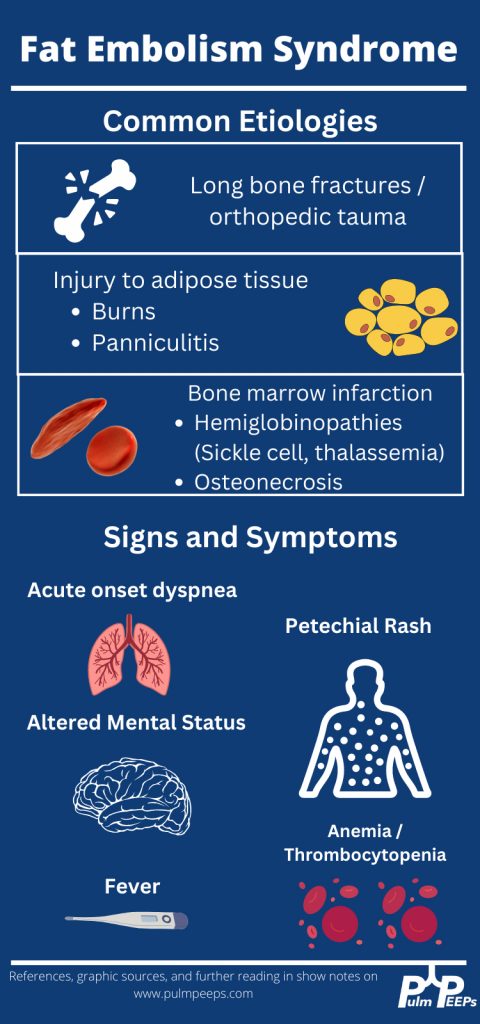
Stein PD, Yaekoub AY, Matta F, Kleerekoper M. Fat embolism syndrome. Am J Med Sci. 2008 Dec;336(6):472-7. doi: 10.1097/MAJ.0b013e318172f5d2. PMID: 19092320.

Kainoh T, Iriyama H, Komori A, Saitoh D, Naito T, Abe T. Risk Factors of Fat Embolism Syndrome After Trauma: A Nested Case-Control Study With the Use of a Nationwide Trauma Registry in Japan. Chest. 2021 Mar;159(3):1064-1071. doi: 10.1016/j.chest.2020.09.268. Epub 2020 Oct 13. PMID: 33058815.

Lara AR, Schwarz MI. Diffuse alveolar hemorrhage. Chest. 2010 May;137(5):1164-71. doi: 10.1378/chest.08-2084. PMID: 20442117.

11. Meet the Patients Series: Katie Fielding on Living with Cystic Fibrosis

We are extremely excited to introduce our new Pulm PEEPs Meet the Patients series. Teaching and learning medicine is an incredible journey, and the goal is always to be improving patient care. Patients are our best teachers about the diseases we encounter, so the goal of this series is to spend more time with patients with pulmonary disease and with those who have been critically ill. For our first episode, we are thrilled to be joined by Katie Fielding.

Katie s an educator and spent 13 years teaching high school science. She now specializes in integrating technology into the classroom to enhance education. Katie was diagnosed with CF as an infant and has spent years as a patient advocate. She works closely with the Cystic Fibrosis Foundation and serves on the Adult Advocacy Council.

Katie gives us an incredible perspective about what it is like to live with Cystic Fibrosis, how her life has changed with modern therapies, and how to be the best provider possible.

1. Meet the PEEPs!

We are excited to introduce Pulm PEEPs to the world! Our mission is to provide learners of all levels with multiple formats to engage in pulmonary and critical care education that you can access anytime. In addition to podcast episodes, we will be sharing helpful infographics and guides to shed light on topics throughout pulmonary and critical care from the bread-and-butter to the esoteric and complex. We will be gathering insights from world experts in the hope to share their knowledge and make it accessible for all. This is only the beginning and please join us each step of the way!

In this introductory episdoe you get to meet the PEEPs!

Kristina “Monty” Montemayor and Dave “Furf” Furfaro are the Co-Founders of Pulm PEEPs. They first met during residency at Johns Hopkins and share a love for medical education and all topics pulmonary and critical care related.

Ansa Razzaq is a Chief Resident in the internal medicine residency at New York-Presbyterian Hospital / Columbia University. She is interested in medical education and pulmonary and critical care medicine. She’ll be bringing amazing cases and helping us work through them from presentation to treatment.