
Furf and Monty are back! For our first episode back in the studio, we’re returning with a Pulm PEEPs Pearls episode on a test that is showing up more and more in pulmonary clinic: fractional exhaled nitric oxide, or FeNO. Using a patient with asthma-like symptoms and a FeNO that lands right in the middle, Furf and Monty walk through what the test measures, how to interpret the number, what can push it up or down, and how to use it for both diagnosis and monitoring.
Contributors
This episode was prepared with research by Pulm PEEPs Associate Editor George Doumat.
Key Learning Points
The Case
A 28-year-old accountant presents with six months of episodic cough and wheeze. Her spirometry is normal with no bronchodilator response, but her FeNO comes back at 42 ppb. Does she have asthma?
The honest answer: maybe. FeNO is not a yes/no asthma test, and a single number has to be interpreted in clinical context.
What Is FeNO Measuring?
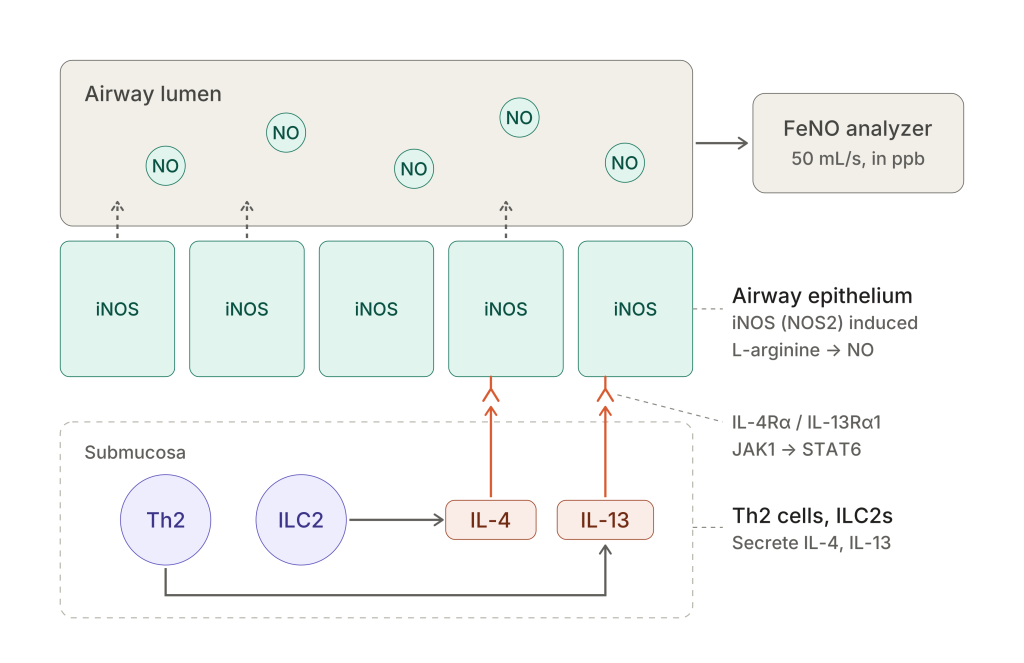
FeNO measures the concentration of nitric oxide in exhaled breath. In type 2 airway inflammation, Th2 cells and ILC2s release IL-4 and IL-13, which signal through the IL-4Rα/IL-13Rα1 receptor (JAK1 → STAT6) to induce iNOS (NOS2) in airway epithelial cells. iNOS converts L-arginine to nitric oxide, which diffuses into the airway lumen and is measured by the analyzer at a standardized exhalation flow of 50 mL/s, reported in parts per billion (ppb).
Bottom line: FeNO gives us a window into type 2 (eosinophilic, allergic-pathway) airway inflammation at the cellular level, something spirometry can’t tell us.
Three Tests, Three Questions
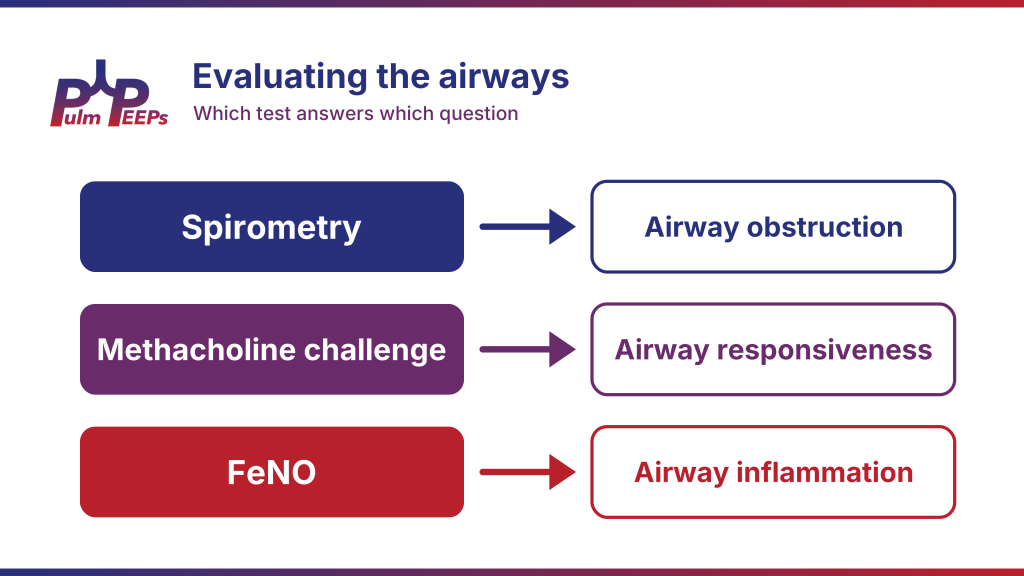
Each airway test answers a different question, and all three can feed into an asthma diagnosis:
| Test | Question It Answers |
|---|---|
| Spirometry | Is there airflow obstruction? |
| Methacholine challenge | Is there airway hyperresponsiveness? |
| FeNO | Is there type 2 airway inflammation? |
These tests don’t always point in the same direction. A patient can have normal spirometry and a negative methacholine challenge but still have an elevated FeNO if there is active eosinophilic inflammation, and the reverse can happen too.
Interpreting the Number
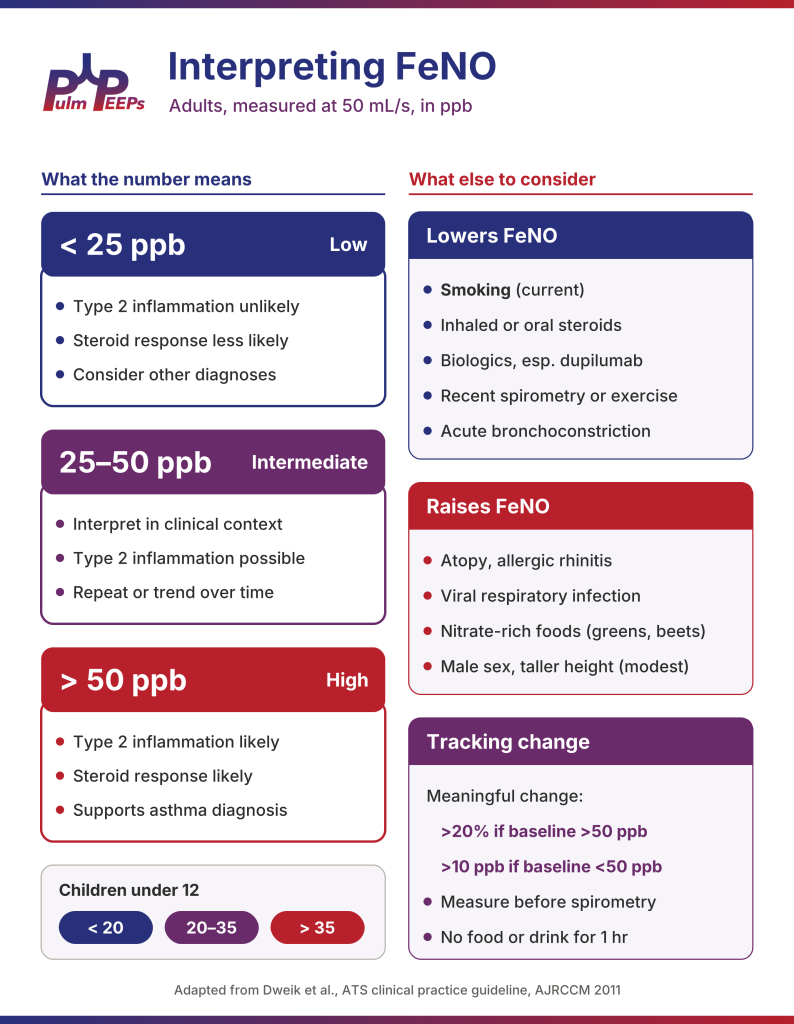
The ATS thresholds for adults are easy to remember because they move in 25s:
| FeNO (adults) | Category | What It Suggests |
|---|---|---|
| < 25 ppb | Low | Type 2 inflammation unlikely; steroid response less likely; consider other diagnoses |
| 25–50 ppb | Intermediate | Type 2 inflammation possible; interpret in clinical context; repeat or trend over time |
| > 50 ppb | High | Type 2 inflammation likely; steroid response likely; supports an asthma diagnosis in the right context |
The extremes are your friends. A value below 25 ppb or above 50 ppb is far more actionable than one in the intermediate range. In the 25–50 zone, we have to do some doctoring.
Children are different: in children under 12, cutoffs are < 20 ppb (low), 20–35 ppb (intermediate), and > 35 ppb (high). Don’t carry adult thresholds over.
What Moves the Number
Before interpreting a value, think about what might be confounding it.
Lowers FeNO:
- Current smoking. A “normal” value in a smoker can be falsely reassuring.
- Inhaled or oral corticosteroids, which suppress the type 2 signal.
- Biologics, especially dupilumab (which blocks IL-4Rα).
- Recent spirometry or exercise.
- Acute bronchoconstriction. A patient in a severe flare can’t exhale fully, so the value may be artificially low. This is not a test for the middle of an exacerbation.
Raises FeNO:
- Atopy and allergic rhinitis, or ongoing allergen exposure
- Viral respiratory infection
- Nitrate-rich foods (leafy greens, beets)
- Male sex and taller height (modest effect)
Testing tips: measure FeNO before spirometry, and have patients avoid food and drink for 1 hour beforehand.
Back to Our Patient
Our patient’s FeNO of 42 ppb is intermediate. It isn’t a diagnosis, but this is exactly the scenario where FeNO earns its keep: she has asthma-like symptoms and the usual physiologic testing hasn’t given us an answer. An elevated value adds evidence that a type 2 eosinophilic process may be present in her airways.
Two important caveats:
- A positive FeNO supports the phenotype, but doesn’t close the case. Current asthma guidelines incorporate FeNO into diagnosis and monitoring, but it belongs inside the diagnostic pathway as one more piece of evidence. Patients are sometimes labeled with asthma based on a single intermediate FeNO, only to have a normal methacholine challenge and an entirely different explanation for their symptoms.
- A low FeNO doesn’t rule out asthma. Non-eosinophilic and neutrophilic asthma phenotypes exist, and FeNO isn’t designed to detect them.
Using FeNO to Monitor Asthma
Once a patient carries an asthma diagnosis, FeNO can become actionable.
Persistent symptoms + persistently high FeNO: There is still a type 2 inflammatory signal, but don’t reflexively escalate inhaled corticosteroids. First ask why the signal is still there:
- Is the patient actually taking the ICS (adherence)?
- Are they using the inhaler correctly (technique and delivery)?
- Is there ongoing allergen exposure?
- Is the current anti-inflammatory dose simply inadequate?
Sometimes a high FeNO is telling you about adherence or delivery, not that the prescription isn’t strong enough.
Persistent symptoms + low FeNO: Especially if blood eosinophils are also low, pause before adding more ICS. Consider a different asthma phenotype, an alternative diagnosis, or another contributor to the symptoms. FeNO can keep us from treating every symptom as though it means more steroid.
The evidence: A 2023 systematic review and meta-analysis of 12 RCTs in adults found that FeNO-guided treatment probably reduces exacerbations compared with symptom-guided treatment, with less clear effects on quality of life, lung function, and other outcomes.
Follow the trend, not the cutoff. Once you’re following a patient over time, they become their own control, and the trajectory matters more than whether a value crosses from 48 to 52 ppb. A meaningful change is generally considered:
- > 20% if the baseline is > 50 ppb
- > 10 ppb if the baseline is < 50 ppb
An elevated FeNO that falls meaningfully after starting ICS supports that you’ve actually changed the airway inflammation.
Beyond Asthma: Chronic Cough
FeNO can also help in the workup of chronic cough. A patient with chronic cough, an elevated FeNO, normal spirometry, and a negative methacholine challenge may have non-asthmatic eosinophilic bronchitis, which can respond to inhaled corticosteroids. Systematically working through and crossing off treatable causes is also what allows us to confidently name refractory chronic cough. For more, check out our episode Pulm PEEPs & Irish Thoracic Society: Understanding Refractory Chronic Cough.
The Four Pulm PEEPs Pearls
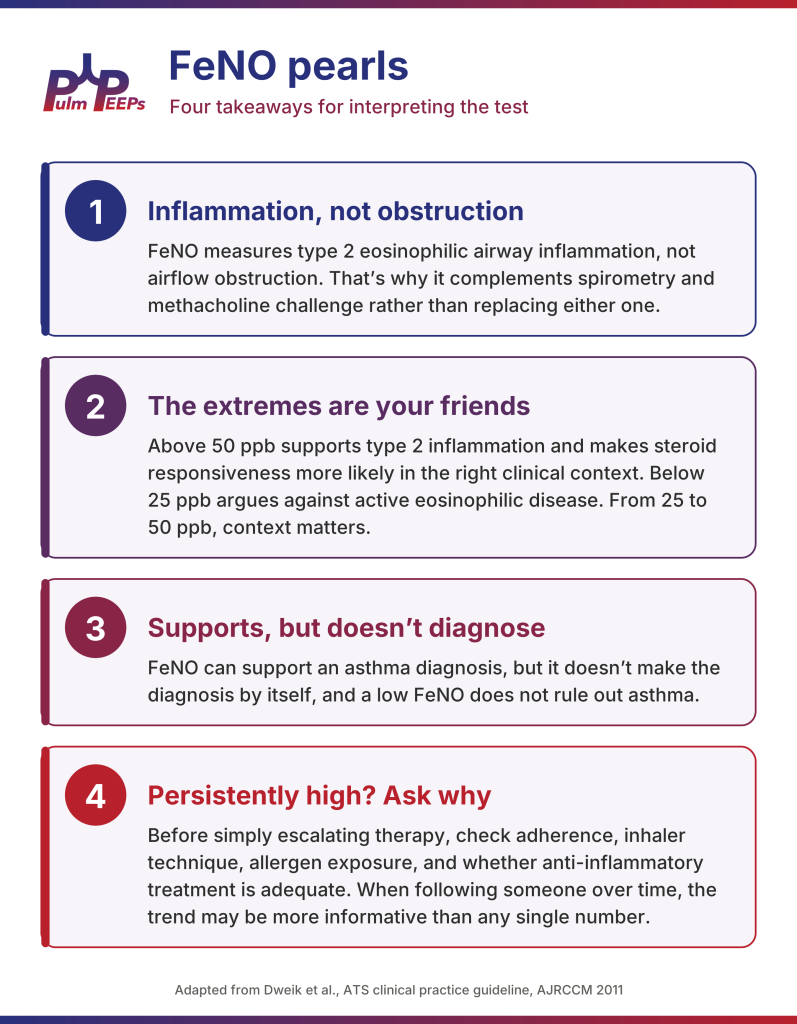
- Inflammation, not obstruction: FeNO measures type 2 eosinophilic airway inflammation, not airflow obstruction. That’s why it complements spirometry and methacholine challenge rather than replacing either one.
- The extremes are your friends: Above 50 ppb supports type 2 inflammation and makes steroid responsiveness more likely in the right clinical context. Below 25 ppb argues against active eosinophilic disease. From 25 to 50 ppb, context matters.
- Supports, but doesn’t diagnose: FeNO can support an asthma diagnosis, but it doesn’t make the diagnosis by itself, and a low FeNO does not rule out asthma.
- Persistently high? Ask why: Before simply escalating therapy, check adherence, inhaler technique, allergen exposure, and whether anti-inflammatory treatment is adequate. When following someone over time, the trend may be more informative than any single number.
Remember: we’re treating the patient, not the FeNO number.
References and Further Reading
Dweik, Raed A et al. “An official ATS clinical practice guideline: interpretation of exhaled nitric oxide levels (FENO) for clinical applications.” American journal of respiratory and critical care medicine vol. 184,5 (2011): 602-15. doi:10.1164/rccm.9120-11ST
American Thoracic Society; European Respiratory Society. “ATS/ERS recommendations for standardized procedures for the online and offline measurement of exhaled lower respiratory nitric oxide and nasal nitric oxide, 2005.” American journal of respiratory and critical care medicine vol. 171,8 (2005): 912-30. doi:10.1164/rccm.200406-710ST
Korevaar, Daniël A et al. “Effectiveness of FeNO-guided treatment in adult asthma patients: A systematic review and meta-analysis.” Clinical and experimental allergy vol. 53,8 (2023): 798-808. doi:10.1111/cea.14359
Petsky, Helen L et al. “Exhaled nitric oxide levels to guide treatment for adults with asthma.” The Cochrane database of systematic reviews vol. 9,9 CD011440. 1 Sep. 2016, doi:10.1002/14651858.CD011440.pub2
Louis, Renaud et al. “European Respiratory Society guidelines for the diagnosis of asthma in adults.” The European respiratory journal vol. 60,3 2101585. 15 Sep. 2022, doi:10.1183/13993003.01585-2021
Expert Panel Working Group of the National Heart, Lung, and Blood Institute (NHLBI). “2020 Focused Updates to the Asthma Management Guidelines: A Report from the National Asthma Education and Prevention Program Coordinating Committee Expert Panel Working Group.” The Journal of allergy and clinical immunology vol. 146,6 (2020): 1217-1270. doi:10.1016/j.jaci.2020.10.003
Global Initiative for Asthma. Global Strategy for Asthma Management and Prevention. Updated annually. Available at ginasthma.org.