123. Critical Care Medicine for Non-Intensivists

Today we’re joined by Dr. Molly Hayes and talking about an upcoming CME course: Principles of Critical Care Medicine for Non-Intensive Care Specialists. This is a wonderful education course covering a wide array of topics in critical care in a case-based, systematic, and peer-reviewed fashion. The course is interactive and all resources will be available for attendees afterwards for their review. You can sign up at https://learn.hms.harvard.edu/criticalmed and save using the discount code “PulmPEEPS50”!

Dr. Molly Hayes is an Associate Professor of Medicine at Beth Israel Deaconess Medical Center and Harvard Medical School, the Director of the MICU at BIDMC, and the Director of External Education at the Carl J Shapiro Institute for Education and Research. She additionally is a co-founder of the BIDMC Center for Humanizing the ICU.

https://learn.hms.harvard.edu/criticalmed

https://www.pulmpeeps.com/2025/08/12/106-pulm-peeps-p…-ici-pneumonitis

Managing Immune Checkpoint Inhibitor Pneumonitis in the ICU. Montemayor, Kristina et al.CHEST Critical Care, Volume 3, Issue 1, 100126

120. Pulm PEEPs & Irish Thoracic Society: Understanding Refractory Chronic Cough

We’re excited today to launch our first episode in collaboration with the Irish Thoracic Society and their podcast series. The Irish Thoracic Society represents respiratory professionals throughout Ireland and is dedicated to championing excellence in the prevention, diagnosis, and clinical care of respiratory disease through its work in advocacy, education and research.

In today’s episode, we explore the complex and often overlooked world of refractory chronic cough — a condition that can significantly impact patients’ quality of life but is frequently misunderstood or underdiagnosed. With insights from leading respiratory specialists in Ireland and the United States, we discuss the latest thinking on diagnosis, management, and emerging treatments aimed at improving outcomes for patients and helping clinicians navigate this challenging area of respiratory medicine.

Joining us are renowned experts Professor Lorcan McGarvey and Professor Brendan Canning, both internationally recognised leaders in respiratory medicine and cough research. Together, they share their perspectives on the neurobiology of chronic cough, the considerable morbidity experienced by patients, and how clinicians can approach diagnostic investigations more effectively.

We also explore current treatment strategies and promising new therapies on the horizon as chronic cough increasingly gains recognition as a disease in its own right — rather than simply a symptom. Whether you’re a clinician, researcher, or simply interested in advances in respiratory medicine, this episode offers valuable insights into a condition that is finally receiving the attention it deserves.

The definitions and classifications of chronic cough, including unexplained, refractory, and unexplained refractory cough

The importance of a thorough clinical history and focused diagnostics over exhaustive testing

Common causes of chronic cough

The role of personalized, multidisciplinary management—combining pharmacologic, speech therapy, and psychological support—to improve quality of life for even the most challenging patients.

The concept of cough hypersensitivity syndrome and its role in refractory cases

Evidence-based approach to treatment, including pharmacologic and non-pharmacologic options

Emerging therapies on the horizon, including novel receptor modulators and neuromodulatory agents and ongoing clinical trials in this rapidly evolving field

The impact of chronic cough on mental health, social life, and overall quality of life

The importance of reframing chronic cough as a disease entity in its own right

Chung KF, Pavord ID. Prevalence, pathogenesis, and causes of chronic cough. Lancet. 2008;371(9621):1364-1374.

Gibson PG, Vertigan AE. Management of chronic refractory cough. BMJ. 2015;351:h5590.

Matsumoto H, Kanemitsu Y, Ohe M, Tanaka H, Terada K, Nishi K, et al. Real-world usage and response to gefapixant in refractory chronic cough. ERJ Open Res. 2025;11(4):01037-2024. doi:10.1183/23120541.01037-2024.

McGarvey LP, Birring SS. Cough hypersensitivity syndrome: a novel paradigm for understanding cough. Lancet Respir Med. 2014;2(8):647-656.

Morice AH, Millqvist E, Bieksiene K, Birring SS, Dicpinigaitis P, Ribas CD, et al. ERS guidelines on the diagnosis and treatment of chronic cough in adults and children. Eur Respir J. 2020;55(1):1901136.

Parker SM, Smith JA, Birring SS, Chamberlain-Mitchell S, Gruffydd-Jones K, Haines J, et al. British Thoracic Society clinical statement on chronic cough in adults. Thorax. 2023;78(Suppl 1):S3-S19.

Smith JA, Woodcock A. Chronic cough. N Engl J Med. 2006;354(2):136-144.

Song WJ, Dupont L, Birring SS, Chung KF, Dąbrowska M, Dicpinigaitis P, et al. Consensus goals and standards for specialist cough clinics: the NEUROCOUGH international Delphi study. ERJ Open Res. 2023;9(6):00618-2023. doi:10.1183/23120541.00618-2023.

Song WJ, McGarvey L, Cho PSP, Mazzone SB, Chung KF, editors. Chronic cough. Sheffield: European Respiratory Society; 2025.

108. Journal Club with BMJ Thorax – Bronchiectasis

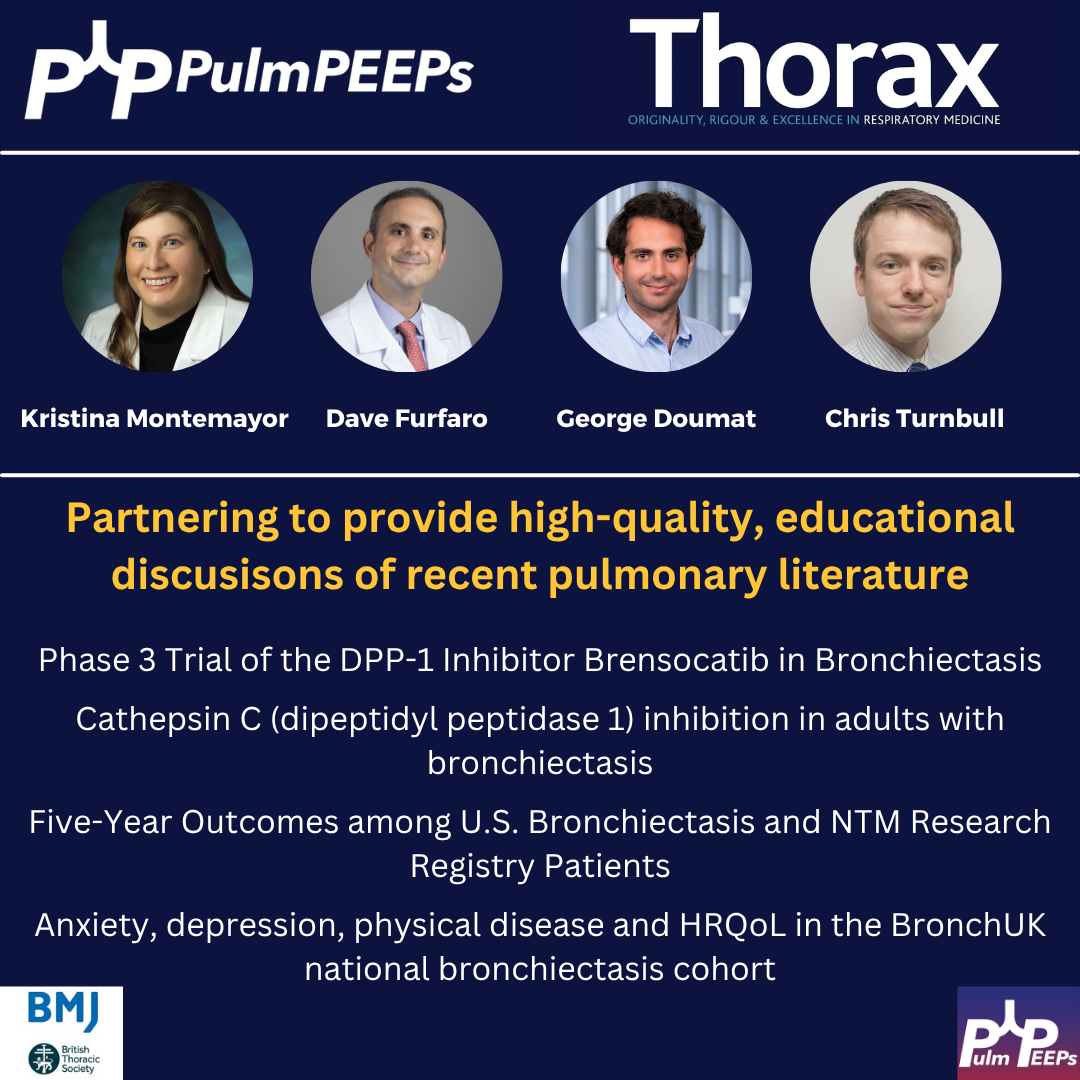
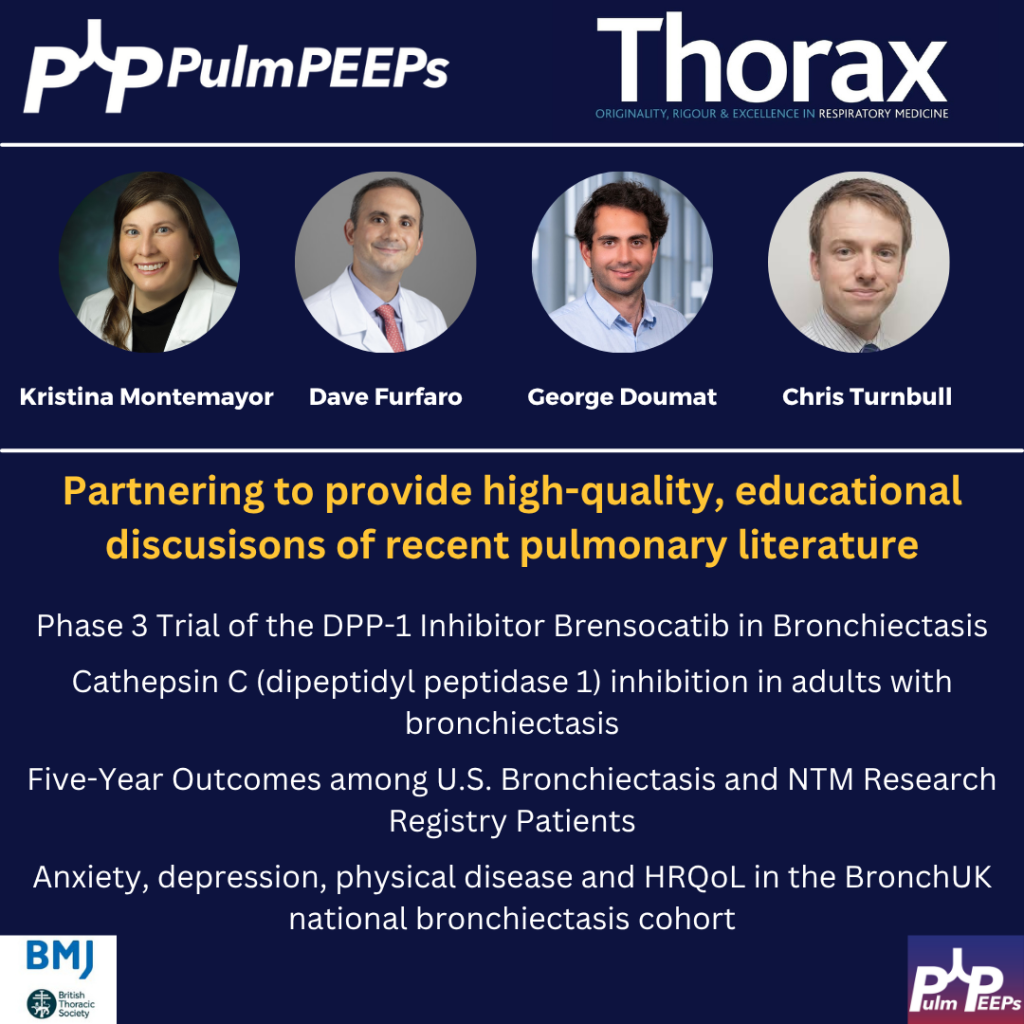
We’re back with our 4th episode in our collaborative series with BMJ Thorax. This week’s episode covers four articles related to bronchiectasis and covers a range of topics in this domain including novel therapeutics, registry data to understand risk, and health related quality of life.

Our mission at Pulm PEEPs is to disseminate and promote pulmonary and critical care education, and we highly value the importance of peer reviewed journals in this endeavor. Each month in BMJ Thorax, a journal club is published looking at high yield and impactful publications in pulmonary medicine. We will be putting out quarterly episodes in association with Thorax to discuss a journal club publication and synthesize four valuable papers.

Chris Turnbull is an Associate Editor for Education at Thorax. He is an Honorary Researcher and Respiratory Medicine Consultant at Oxford University Hospitals. In addition to his role as Associate Editor for Education at BMJ Thorax, he is also a prominent researcher in sleep-related breathing disorders.

Dr. George Doumat completed his medical school at the American University of Beirut and now is an internal medicine resident at UT south western in his second year of training. Prior to starting residency he was a research fellow at MGH studying chronic lung disease.

To submit a journal club article of your own to Thorax, you can contact Chris directly – christopher.turnbull@ouh.nhs.uk


To engage with Thorax, please use the social media channels (Twitter – @ThoraxBMJ; Facebook – Thorax.BMJ) and subscribe on your preferred platform, to get the latest episodes directly on your device each month.

  • Four recent papers (2 RCTs, 2 large cohorts) chosen to show both new therapeutics and real-world comorbidities/outcomes, pushing toward precision medicine.

1) ASPEN trial – brensocatib (DPP-1 inhibitor)

  • Design: Phase 3, ~1,700 pts, 35 countries, 52 weeks; stratified randomization by region.
  • Results: ↓ annualized exacerbation rate (~1.0 vs 1.3/yr; RR≈0.8), longer time to first exacerbation, ~10% absolute ↑ in “exacerbation-free” patients at 1 year, QoL improved, modest FEV1 decline difference (~40 mL/yr).
  • Take: First targeted therapy with consistent benefit; effect on lung function small but directionally supportive.
  • Gaps: Need long-term durability, adolescent data, and comparisons/positioning in pts with asthma/COPD overlap.

2) AIRLEAF (BI 1291583) – reversible cathepsin C inhibitor

  • Design: Phase 2, 4 arms (3 doses + placebo), model-based dose–response analysis to optimize dose selection.
  • Results: Overall dose–response signal; individual low-dose arms trended to fewer exacerbations but not statistically significant; skin events more common at higher doses.
  • Take: Promising class targeting neutrophil pathway, but needs Phase 3 before clinical use.

3) U.S. Bronchiectasis & NTM Registry – 5-year outcomes

  • Cohort: >2,600 CT-confirmed; ~59% with baseline NTM identified.
  • Results: 5-yr mortality ~12%; no mortality difference with vs without NTM; predictors = lower baseline FEV1, older age, male sex, prior hospitalization. FEV1 decline ~38 mL/yr. Baseline NTM group had fewer exacerbations (counterintuitive).
  • Interpretation cautions: Likely mix of colonization vs active disease; referral/management effects in specialized centers; registry strengths (size, real-world, longitudinal) vs pitfalls (confounding, data quality, causality).

4) Bronch-UK cohort – anxiety & depression

  • Cohort: 1,340 adults; HADS screening.
  • Prevalence: Anxiety ~33%, depression ~20%; many undiagnosed (≈26%/16%).
  • Impact: Worse QoL, more severe disease; depression ~1.8× higher hospitalization risk and shorter time to severe exacerbation.
  • Caveat: Association ≠ causation; sicker patients may have more mental health burden.

Practical takeaways for clinic

  • Consider brensocatib for appropriate non-CF bronchiectasis patients once accessible; frame benefits around fewer exacerbations and QoL, not big lung function gains.
  • Do not introduce cathepsin C inhibitors outside trials yet; discuss as pipeline only.
  • Risk stratify using FEV1, age, sex, and prior hospitalizations; expect ~40 mL/yr average FEV1 decline.
  • Screen mental health routinely (HADS, PHQ-9, GAD-7). Build multidisciplinary pathways; consider brief CBT-style supports embedded in bronchiectasis clinics, with targeted referrals.
  • Registry data ≠ RCTs: Use for counseling and service design, but avoid causal claims.

Research/implementation gaps highlighted

  • Long-term safety/efficacy and subgroup effects for brensocatib (adolescents, asthma/COPD overlap).
  • Phase 3 confirmation for cathepsin C inhibition and dose selection.
  • Granular NTM phenotyping (colonization vs disease) to reconcile paradoxical exacerbation signals.
  • Scalable mental-health interventions integrated into respiratory clinics; trials to test impact on exacerbations/hospitalizations.

Pro tip from the episode

104. Pulm PEEPs on Core IM – Pleural Effusions

Hi Pulm PEEPs! Today we have a special episode for you. Monty and Furf were invited on the Core IM Podcast to talk about the work up and management of pleural effusions. This is a great overview and we hope you enjoy listening as much as we did recording. If you want a deeper dive into pleural effusions check out our prior series:

36. Top Consults Series: Approach to Pleural Effusions


37. Top Consults: Approach to Parapneumonic Effusions

49. Top Consults: Malignant Pleural Effusions

102. Journal Club with BMJ Thorax – Sleep and Non-Invasive Ventilation

Today is our third episode in our collaborative series with BMJ Thorax. Our mission at Pulm PEEPs is to disseminate and promote pulmonary and critical care education, and we highly value the importance of peer reviewed journals in this endeavor. Each month in BMJ Thorax, a journal club is published looking at high yield and impactful publications in pulmonary medicine. We will be putting out quarterly episodes in association with Thorax to discuss a journal club publication and synthesize four valuable papers. This week’s episode covers four articles related to obstructive sleep apnea therapies, and the use of non-invasive ventilation and high flow nasal cannula for intubation and COPD exacerbations.

Chris Turnbull is an Associate Editor for Education at Thorax. He is an Honorary Researcher and Respiratory Medicine Consultant at Oxford University Hospitals. In addition to his role as Associate Editor for Education at BMJ Thorax, he is also a prominent researcher in sleep-related breathing disorders.

Natalie McLeod is  a resident in respiratory medicine and is currently doing a clinical fellowship in sleep and ventilation at Oxford University Hospitals.

To submit a journal club article of your own to Thorax, you can contact Chris directly – christopher.turnbull@ouh.nhs.uk


To engage with Thorax, please use the social media channels (Twitter – @ThoraxBMJ; Facebook – Thorax.BMJ) and subscribe on your preferred platform, to get the latest episodes directly on your device each month.

92. Journal Club with BMJ Thorax – COPD and Emphysema

Today is our second episode in our collaborative series with BMJ Thorax. Our mission at Pulm PEEPs is to disseminate and promote pulmonary and critical care education, and we highly value the importance of peer reviewed journals in this endeavor. Each month in BMJ Thorax, a journal club is published looking at high yield and impactful publications in pulmonary medicine. We will be putting out quarterly episodes in association with Thorax to discuss a journal club publication and synthesize four valuable papers. This week’s episode covers four articles related to lung health, COPD, and emphysema.

Chris Turnbull is an Associate Editor for Education at Thorax. He is an Honorary Researcher and Respiratory Medicine Consultant at Oxford University Hospitals. In addition to his role as Associate Editor for Education at BMJ Thorax, he is also a prominent researcher in sleep-related breathing disorders.

 Ewan Mackay is a Respiratory Clinical Research Fellow who has started his PhD in London. His research focus is on chronic cough and in the development of new patient-reported outcome measures as well as respiratory physiology, particularly in relation to exercise and disease.

To submit a journal club article of your own to Thorax, you can contact Chris directly – christopher.turnbull@ouh.nhs.uk


To engage with Thorax, please use the social media channels (Twitter – @ThoraxBMJ; Facebook – Thorax.BMJ) and subscribe on your preferred platform, to get the latest episodes directly on your device each month.

85. Journal Club with BMJ Thorax – Airway Disease

We are extremely excited today to announce a new collaboration with BMJ Thorax. Our mission at Pulm PEEPs is to disseminate and promote pulmonary and critical care education, and we highly value the importance of peer reviewed journals in this endeavor. Each month in BMJ Thorax, a journal club is published looking at high yield and impactful publications in pulmonary medicine. We will be putting out quarterly episodes in association with Thorax to discuss a journal club publication and synthesize four valuable papers. We hope you enjoy!

Chris Turnbull is an Associate Editor for Education at Thorax. He is an Honorary Researcher and Respiratory Medicine Consultant at Oxford University Hospitals. In addition to his role as Associate Editor for Education at BMJ Thorax, he is also a prominent researcher in sleep-related breathing disorders.

 Imran Howell is an Asthma Fellow at the Nuffield Department of Medicine, University of Oxford

To submit a journal club article of your own to Thorax, you can contact Chris directly – christopher.turnbull@ouh.nhs.uk


To engage with Thorax, please use the social media channels (Twitter – @ThoraxBMJ; Facebook – Thorax.BMJ) and subscribe on your preferred platform, to get the latest episodes directly on your device each month.

70. Bronchoscopy Emergencies with Critical Care Time

We’re super excited to have a joint episode this week with Dr. Cyrus Askin and Dr. Nick Mark from Critical Care Time! We discuss all the ways that bronchoscopy can be your best friend in the ICU and how to be prepared for the unexpected scary situations that arise in the ICU. This ranges from airway bleeds, difficult intubations, lobar collapse, and trach emergencies. Don’t miss this great discussion!

Utility of bronchoscopy in people with critical illness

  • Bronchoscopy can be both diagnostic and therapeutic; both are potentially lifesaving. 
  • General situations where bronchoscopy is useful in the ICU:
    • Placing (or confirming placement of) an endotracheal tube or tracheostomy tube
    • Removing a foreign body or mucous plugs from the lungs
    • Localizing the source of pulmonary hemorrhage or performing interventions to stop/contain the bleed
    • Diagnosing certain rare conditions, particularly those where the diagnosis can substantially change management (e.g. DAH, AEP, rare infections, etc).
  • Proficiency with bronchoscopy is important to realize the benefits. Simply “having the equipment” is insufficient, regular practice/simulation is essential
    • Anesthesiologists, emergency physicians, and other specialists may have limited experience with bronchoscopy in training. Even experienced pulmonologists, who may be good at diagnostic bronchoscopy often have limited experience deploying bronchial blockers, using retrieval baskets, etc.
    • Remember: “People don’t rise to the occasion, they sink to the level of their training.”
    • If you haven’t regularly practiced with a bronchoscope, you are not going to be able to use it effectively under stress when performing high acuity low occurrence (HALO) procedures such as in emergent airways, deploying bronchial blockers, retrieving foreign bodies, etc.

Practice practice practice: High fidelity bronchoscopy simulators are available. Low cost bronchoscopy simulators (e.g. 3D printed DIY) are available.

Difficult Airways

  • Two broad situations where a bronchoscope is generally used:
    • Awake intubation in the anticipated difficult airway (e.g. someone with abnormal anatomy, airway tumor, etc)
    • Rescue method in the unanticipated difficult airway (e.g. very anterior cords, difficulty with Bougie, etc)
  • Nasal vs Oral approach:
    • Oral approach is usually used in an unanticipated difficult airway
    • Nasal approach: More common if performing an awake intubation. Nasal is often better tolerated however epistaxis can make a difficult airway almost impossible.
  • Sedation strategy:
    • Full topicalization: lidocaine vs cocaine (equally effective and lidocaine is normally preferred, however the vasoconstriction action of cocaine may be helpful in preventing epistaxis).
      • Which types of topicalization work best?
        • Spray as you go w/ or w/o and atomizer 
        • Nebulization (maybe better? maybe)
        • Gurgling (Nick: from personal experience lidocaine is super gross)
      • Remember total dose of lidocaine: < 8 mg/kg
    • Ketamine
      • Ideal because it’s dissociative and analgesic, maintains respiratory drive and (maybe) airway reflexes
      • Consider scopolamine patch to reduce oral secretions
    • Dexmedetomidine
      • Great adjunct
  • One vs two operator
    • Especially in unanticipated difficult airways; the second operator can use VL/DL to facilitate visualization of the vocal cords.
    • Second operator can also be preparing for a surgical airway.
  • Equipment considerations:
    • Preload the endotracheal tube onto the bronchoscope. Use the bronchoscope as a bougie to guide the ETT through the vocal cords.
    • Suction! You want two – one connected to the bronch and one connected to a yankuer.
    • Disposable vs “good” scope
    • Remember to load the tube first!
    • Also remember to lube the tube!


Tracheostomy troubleshooting 

  • Similarly to intubation, bronchoscopy can be very useful to confirm placement
  • Mechanics are similar to above
  • Goal is to avoid inadvertent placement of the tracheostomy tube into the soft tissues of the neck and to avoid putting air into those tissues (false lumen).
  • Advanced trick for exchanging tubes: You can use a disposable bronchoscope to exchange tubes: you can get it in, confirm placement, then cut it with trauma shears! Now you can slide the old tube out and put a new one in. (Don’t try this on a $40,000 fiberoptic bronchoscope!)
  • Ideally you should load the ETT onto the bronchoscope in advance (red arrow). If necessary however, you can cut the ETT and turn the disposable bronchoscope into a improvised exchange catheter. This technique is very useful for exchanging tracheostomy tubes.


Foreign Body Removal from airways

  • Bronchoscopy is invaluable for both diagnosis and treatment of foreign body aspirations. 
  • Most commonly these aspirations are food (nuts, seeds, etc), teeth, pills, etc
  • Great overview of the procedure.
  • Intubated vs awake
    • Intubated is harder in many cases: no cough to help, hard to get foreign body out of the ETT.
  • Flexible vs rigid
    • Most objects can be retrieved using flexible bronchoscope; however 15-20% require rigid bronchoscopy 
    • Flexible can reach smaller foreign bodies that are lodged more distally.
    • Rigid bronchoscopy is usually done if flexible bronchoscopy fails; an interventional pulmonologist wielding a rigid is superior but more invasive (requires GA)
  • Many different retrieval devices; technique depends on what equipment is available.
    • Forceps
      • Many types: shark tooth, rat tooth, alligator are most common
    • Basket
    • Grasper
    • Snare
    • Net (GI device repurposed)
    • Cryoprobe can be especially useful for frangible materials (e.g. food)


Mucous Plugs & Lobar collapse

  • Presentation can be subtle or dramatic.
  • Bronchoscopy can remove mucous plugs and help re-expand collapsed lung areas, which is potentially life saving.
  • Additionally, bronchoscopy can permit diagnosis of tracheal bronchus (bronchus sui)
    • Pig bronchus – 1-3% of people – have a RUL bronchus that comes off the trachea. 
    • Often presents with RUL collapse in an intubated person.
  • Suction considerations and bronchoscope size
    • Remember that suctioning force is highly dependent (i.e. radius raised to the fourth power!) upon the working channel size. Use the largest size bronchoscopy possible when suctioning.
  • Remember that other interventions: regular inline suctioning, chest PT, adequate hydration, mucolytics are also important to prevent recurrent mucous plugging.


Localization & Isolation of Pulmonary Hemorrhage

  • Pre-bronch interventions
    • Stabilization
    • Nebulized TXA
    • Bad side down → counter-intuitive because shifting blood flow, but also the goal is to protect the non-bleeding lung.
    • etc
  • Bronch can localize the bleeding site. Bronch can also perform interventions such as:
    • Cold saline
    • Epinephrine 1:100,000
    • Bronchial blockers – comparison of types
      • CRE balloon
      • Fogarty
    • Cryo probe – great for removing clots
    • Delivering ETT to contralateral side → single lung ventilation


Making “bronchoscopy only” diagnoses

  • Diffuse Alveolar Hemorrhage (DAH)
    • Finding: Increasingly bloody returns on serial lavages
  • Infections not covered by empiric therapies:
    • Invasive fungal infection (e.g. mucor), azole resistant fungi (C glabrata)
    • Rare/unusual infections (PJP, histoplasmosis, etc)
  • Infection mimics:
    • Acute eosinophilic pneumonia (AEP) and chronic eosinophilic pneumonia (CEP)
      • Finding: eosinophils > 20%
    • E-Cigarette Vaping Associated Lung Injury (EVALI)
      • Foamy lymphocytes
    • Organizing Pneumonia
    • Others
  • Remember to always send a cell count on a BAL! And cytology!
  • How often does bronchoscopy change management? Surprisingly often!
    • A study of how often bronchoscopy changes management in an oncology population. 500+ patients with AML or high grade myeloid neoplasms who underwent bronchoscopy at one center over 5+ years.
    • 1) an unexpected diagnosis was made and followed by a management change (as the most rigorous estimate of utility)
      • 13% of the time a diagnosis was only made because of bronchoscopy which changed management 
    •  2) the post-bronchoscopy diagnosis was discordant from the leading diagnosis considered before this procedure and was followed by a management change
      • 48% of the time pre and post procedure leading diagnoses were different
      • 26% of the time the change in leading diagnosis led to a change in therapy
    • 3) a change in management was made following bronchoscopy regardless of whether the diagnosis was expected or considered.
      • 32% escalation of antibiotics
      • 30% de-escalation of antibiotics
      • 9% addition of steroids
      • 2% mold → surgery
  • Remember that in critically ill patients whose symptoms are unexplained or failing to resolve with therapy, diagnostic flexible bronchscopy can provide useful insights.


61. PulmPEEPs and ICU Ed and Todd-Cast: ACORN Trial

This week we are excited to bring you our podcast cross-over event as we are joined by Eddie Qian and Todd Rice, the co-founders of the ICU Ed and Todd-Cast. Listen today as we discuss the recent ACORN trial evaluating the use of Cefepime versus Pipercillin-Tazobactam in adults hospitalized with acute infection.

References: Qian ET, Casey JD, Wright A, Wang L, Shotwell MS, Siemann JK, Dear ML, Stollings JL, Lloyd BD, Marvi TK, Seitz KP, Nelson GE, Wright PW, Siew ED, Dennis BM, Wrenn JO, Andereck JW, Han JH, Self WH, Semler MW, Rice TW; Vanderbilt Center for Learning Healthcare and the Pragmatic Critical Care Research Group. Cefepime vs Piperacillin-Tazobactam in Adults Hospitalized With Acute Infection: The ACORN Randomized Clinical Trial. JAMA. 2023 Oct 24;330(16):1557-1567.

55. The Autumn Ghost

We are excited to bring you a special episode where we are joined by author Dr. Hanna Wunsch and will discuss her book, “The Autumn Ghost: How the Battle Against a Polio Epidemic Revolutionized Modern Medical Care.

Meet our Guests

Dr. Hannah Wunsch a Professor of Anesthesiology and Critical Care Medicine at the University of Toronto and is an intensivist at Sunnybrook Hospital. Hannah completed her medical training at Washington University School of Medicine and  received a Master’s Degree in Epidemiology from the London School of Hygiene and Tropical Medicine. She completed her anesthesia residency and critical care fellowship at Columbia University in New York and was on faculty there for 6 years prior to moving to Toronto. The Autumn Ghost is her first book.

In The Autumn Ghost, Dr. Hannah Wunsch shares the story of the polio epidemic in the autumn of 1952 in Copenhagen. She masterfully tells the story of how specialties came together to advance mechanical ventilation and intensive care units, and connects history to modern day medicine.