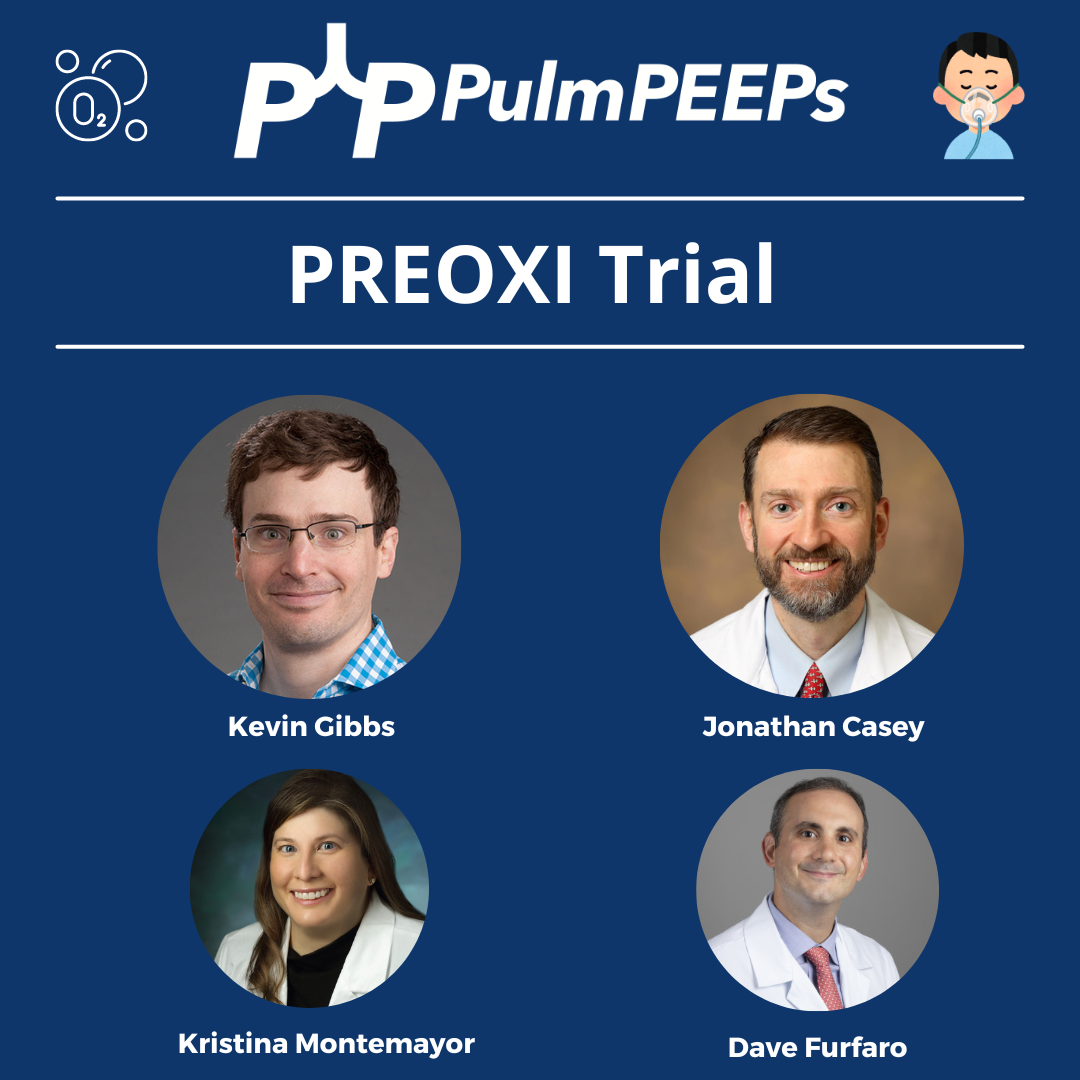
Today, we’re going to be talking about pre-oxygenation methods for endotracheal intubation and the PREOXI Trial which is hot off the presses in the New England Journal of Medicine in June of 2024. This trial has potentially widespread, practice changing results and we’re lucky enough to be joined by two of the authors to discuss.
Meet Our Guests
Dr. Kevin Gibbs is an Associate Professor of Medicine at Wake Forest University School of Medicine. He obtained his MD at George Washington University School of Medicine, and completed his residency and fellowship training at Johns Hopkins. He is an active researcher in critical care, ARDS, mechanical ventilation, and pragmatic trial design.
Dr. Jon Casey is an Assistant Professor of Medicine for the Division of Allergy, Pulmonary, and Critical Care Medicine at Vanderbilt University Medical Center. He obtained his MD from the University of Louisville School of Medicine, and completed his residency training at Brigham and Women’s Hospital before going to Vanderbilt for fellowship training. He is a physician scientist and also has his Masters of Science in Clinical Investigation. His research is focused on comparative effectiveness of ICU treatments and he also has a focus on pragmatic trials. He is supported with NIH funding and is active in the American Thoracic Society Critical Care Assembly.
Summarized Key Points
- Significance of the Problem: Tracheal intubation in emergency and ICU settings is common, with significant risks such as hypoxemia (10-20% incidence) and cardiac arrest (2% incidence) associated with the procedure. This makes effective pre-oxygenation crucial.
- Methods of Pre-oxygenation: Common methods include face mask oxygen (e.g., non-rebreather, bag-mask devices) and more advanced techniques like non-invasive ventilation (used in about 15% of cases globally). Each method has pros (e.g., simplicity, no risk of aspiration for face masks; 100% oxygen delivery, positive pressure for non-invasive ventilation) and cons (e.g., potential for gastric insufflation with non-invasive ventilation).
- Study Design: The study discussed in the podcast is a pragmatic trial aiming to optimize pre-oxygenation strategies to prevent peri-intubation hypoxemia. Eligibility criteria were broad, encompassing most patients undergoing tracheal intubation in the ED or ICU, with exclusions mainly for safety reasons.
- Primary Outcome: The primary outcome of the trial was hypoxemia, defined as oxygen saturation < 85%. This threshold was chosen because it signifies a critical point on the oxygen dissociation curve, where patients are at higher risk of further desaturation and adverse outcomes.
- Secondary Outcomes: Secondary exploratory outcomes included more severe levels of hypoxemia (oxygen saturation < 80% and < 70%), aiming to capture varying degrees of oxygenation failure during intubation. Rates of cardiac arrest during intubation were an additional outcome.
- Intervention Comparison:
- The trial compared two methods of pre-oxygenation: non-invasive ventilation (NIV) and oxygen mask (face mask)
- Both methods aimed to provide at least three minutes of pre-oxygenation before intubation.
- NIV group specifics: Expiratory pressure of 5 cm H2O, Inspiratory pressure of 10 cm H2O, respiratory rate of 10 breaths per minute, and 100% oxygen delivery
- Oxygen mask group specifics: Non-rebreather or bag mask device with at least 15 liters per minute oxygen flow.
- Nasal cannulas and HFNC could be used in both groups.
- Logistics and Equipment Use:
- The trial allowed flexibility in using available equipment (invasive ventilator capable of NIPPV vs. dedicated BiPAP machine).
- Sites were encouraged to use the same ventilator for both pre-oxygenation and subsequent ventilation to streamline workflow and reduce logistical challenges.
- Primary and Secondary Outcomes:
- Results showed a significant reduction in hypoxemia incidents in the NIV group compared to the oxygen mask group.
- There was also a reduction in severe hypoxemia and a notable decrease in cardiac arrest incidents in the NIV group.
- Aspiration Safety:
- There was no statistical difference in aspiration-related outcomes between the NIV and oxygen mask groups, indicating that NIV did not increase the risk of aspiration.
- Conclusions:
- The trial concluded that NIV for pre-oxygenation significantly reduced the incidence of hypoxemia and possibly cardiac arrest during tracheal intubation.
- It also dispelled concerns about increased aspiration risk with NIPPV as pre-oxygenation, suggesting it can be safely used in clinical practice.
Reference
Gibbs KW, Semler MW, Driver BE, Seitz KP, Stempek SB, Taylor C, Resnick-Ault D, White HD, Gandotra S, Doerschug KC, Mohamed A, Prekker ME, Khan A, Gaillard JP, Andrea L, Aggarwal NR, Brainard JC, Barnett LH, Halliday SJ, Blinder V, Dagan A, Whitson MR, Schauer SG, Walker JE Jr, Barker AB, Palakshappa JA, Muhs A, Wozniak JM, Kramer PJ, Withers C, Ghamande SA, Russell DW, Schwartz A, Moskowitz A, Hansen SJ, Allada G, Goranson JK, Fein DG, Sottile PD, Kelly N, Alwood SM, Long MT, Malhotra R, Shapiro NI, Page DB, Long BJ, Thomas CB, Trent SA, Janz DR, Rice TW, Self WH, Bebarta VS, Lloyd BD, Rhoads J, Womack K, Imhoff B, Ginde AA, Casey JD; PREOXI Investigators and the Pragmatic Critical Care Research Group. Noninvasive Ventilation for Preoxygenation during Emergency Intubation. N Engl J Med. 2024 Jun 20;390(23):2165-2177. doi: 10.1056/NEJMoa2313680. Epub 2024 Jun 13. PMID: 38869091.
Podcast: Play in new window | Download
Subscribe: Apple Podcasts | Spotify | Amazon Music | Android | iHeartRadio | Podcast Index |
Podcast (pulm-peeps-video): Play in new window | Download